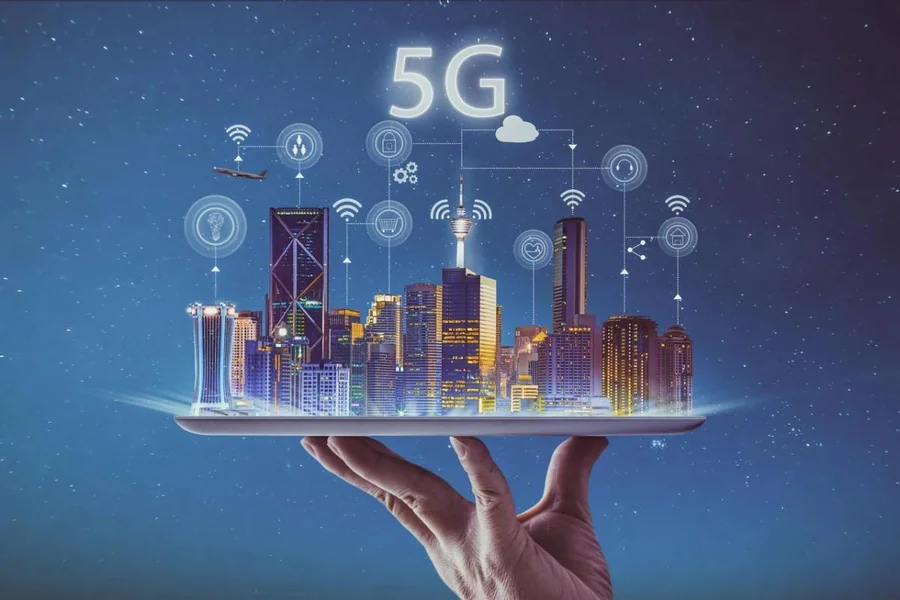
5G is associated with sensors and mostly with faster downloads for their phones. That’s not all.
However, for businesses, it is elsewhere that the actual value is. The 5G will be linking up machines, sensors, and cameras in factories, hospitals, ports, farms, and warehouses. This isn’t only about 5G mobile technology; it’s about how 5G is going to change businesses—and it gives you the results and what business leaders should be considering for investment.
What Does 5G Mean for Business?
The key points of 5G technology changing the face of business, other than the smartphone, are very low delay, high capacity, and reliable wireless connections. These enable companies to wire thousands of sensors, robots, vehicles, and cameras together in real time. This leads to automation, remote operation, and quicker decisions in various industries, including manufacturing, health, logistics, retail, and energy, with no need for cables or slow networks.
Why 5G Is More Than a Faster Phone Network
5G is a mobile communications standard but has a much more profound basis than consumer usage. The targets laid down by the International Telecommunication Union (ITU) for 5G are very high peak speeds, latency as low as one millisecond, and support for up to one million connected devices per square kilometer. These are design targets, and actual performance will vary with the network and location.
There are three features of importance to businesses:
- Low latency: No delay in data transmission. In the case of robots, remote machinery as well as safety systems is important.
- Large numbers of IoT sensors can be supported by one network.
- Network slicing: the network can be sliced into multiple virtual network lanes, customized to a specific task.
- Together, these networks are a testament to the impact 5G technology is having on business—beyond the smartphone! The Wi-Fi and 4G are for those who are seeking to browse and stream. 5G also has the ability to connect machines.
Together, these features explain how 5G technology is transforming business beyond smartphones. Wi-Fi and 4G were built for people browsing and streaming. 5G was built to connect machines as well.
5G vs 4G for Business Use
| Feature | 4G | 5G |
| Typical focus | Mobile broadband for people | People, machines and sensors |
| Latency | Higher, noticeable in real-time control | Much lower, suited to real-time tasks |
| Device capacity | Limited in crowded areas | Designed for very dense IoT deployments |
| Private networks | Possible but limited | Strong support for dedicated enterprise networks |
| Network slicing | Not available | Available on 5G standalone networks |
Smart Manufacturing and Industry 4.0
One of the most apparent use cases of 5G in business is 5G manufacturing.
Cables, as a way of reliable machine control, have been a part of factories for a long time. Cables are costly to install and hard to move. A private 5G network is a secure wireless connection for production lines.
Common uses include:
- Link up sensors for predictive maintenance
- Driving automated guided vehicles (AGVs) around the floor.
- Employing camera-based quality inspection system.
- Support for Augmented Reality when making repairs and training workers
Machines can be reconfigured without rewiring to be faster to re-configure production layouts. This flexibility is one of the reasons why industrial companies are looking at the private 5G networks.
Healthcare and Remote Care
Devices that don’t have time to wait for unreliable or insecure connections are not an option for hospitals.
With 5G, remote monitoring of patients, high-quality video consultations and rapid transfer of large medical images are possible. For some of the pilot projects, the required protocols have been observed remotely by the experts through low latency communications. These are still early stages of development, but give an understanding of a direction in which connected care is moving.
Another such example is ambulances. A 5G connected ambulance can send patient data to the hospital even before its arrival, which enables the staff to prepare in advance.
Logistics, Ports and Supply Chains
Where are products at all times is the key to logistics. 5G is aiding by linking trackers, forklifts, trucks and cranes onto a network.
The advantages are most pronounced for ports and big warehouses. They can be used in big spaces, inaccessible to Wi-Fi and demand a lot of equipment movement. With 5G, operators will be able to monitor and manage assets, automate vehicles and reduce idling time.
Another realistic aspect of the impact of 5G technology on the business environment, apart from smartphones. When you’re more visible, you’re going to have fewer delays and better planning.
Retail and Customer Experience
5G is supporting retailers to connect sensors in stores, smart shelves and cashier-less checkout. Augmented reality try-on tools and real-time inventory updates are made possible through the use of faster networks.
What’s good for the customer: shorter queues and information on the products. It is less lost sales for stores due to empty shelves.
Energy, Utilities and Agriculture
5G-powered sensors are installed on utilities to keep an eye on the grids, pipelines and meters in vast areas. Quick notifications facilitate teams to react to failures early.
In agricultural applications, the connected sensors monitor soil moisture, crop health and equipment performance. This data can be used by farmers to precisely water and treat fields. Adoption of the coverage in rural area is still problematic and also not even in all the places.
Business Use Cases at a Glance
| Industry | Key 5G Use | Main Business Benefit |
| Manufacturing | Private networks, predictive maintenance | Less downtime, flexible production |
| Healthcare | Remote monitoring, medical imaging | Faster, more accessible care |
| Logistics | Asset tracking, automated vehicles | Better visibility, faster handling |
| Retail | Smart shelves, AR experiences | Fewer stockouts, improved service |
| Energy | Grid and pipeline sensors | Quicker fault detection |
| Agriculture | Field sensors, connected machinery | Efficient use of water and inputs |
The Role of Edge Computing and AI
5G is best used in conjunction with other technologies. Edge computing is a technology that processes data closer to the source, decreasing further latency. That information can then be analyzed in realtime by AI, for instance, when there is a defect on a production line.
If these tools did not have seamless connectivity, they are worthless. The concept of 5G technology plus edge computing, AI and IoT is at the core of how 5G is revolutionizing business outside of just smartphones.
Challenges Businesses Should Plan For
While 5G is a strong one, it is not a panacea. These challenges should be taken into account by leaders:
- Expensive investments – Private networks and new devices.
- Access: High-speed 5G isn’t available in all areas, particularly rural regions.
- Security: The more devices that are connected, the more they have to be secured.
- Skills: There is the need for training in network management and IoT.
- Older devices or equipment may require upgrading or gateways.
It’s important to recognize these limits in order to set realistic targets and avoid costly misjudgments by investments—private
How to Start With 5G in Your Business
A gradual plan of approach is a plan that will minimise risk. Consider this path:
- Formulate a well-defined problem. Choose one of the use cases: asset tracking, product inspection.
- Check coverage and options. Talk to your provider about public 5G, network slicing and private 5G.
- Run a small pilot. Test on 1 site or production line.
- Measure results. Monitor downtime, speed, cost and safety.
- Scale carefully. Only grow if successful.
To harness the benefits of 5G technology for the business world beyond the smartphone, a ‘baby step’ approach is the best strategy.
Final Thoughts
5G isn’t just an upgrade for consumers. It’s growing rapidly as essential infrastructure for organizations seeking speedy operations, safer work environments, and smarter data utilization.
Knowing about the utilization of 5G technology in other applications than smartphones gives business leaders insight into where the value is to be found. Best outcomes occur with respect to clearly stated objectives, small pilot projects, and focus on security and cost.
Solve one problem at a time and then try it out and build on that. The ones that recognize the potential of 5G beyond smartphones now will be better armed to do so in the future as connected business becomes the norm.
FAQs
So, what’s the best part about 5G for businesses?
The top selling point is the stable, low-latency wireless connectivity for numerous devices. This allows for automation and real-time decision-making that is more challenging with older networks.
The second question is, what are the differences between 5G and Wi-Fi for business?
Creating Wi-Fi in the building is easy, but not in large areas, handovers, and hand-moving machines. A wider spectrum of coverage, better support for mobility, and greater control over the quality of service are what 5G brings.
Will 5G work for small businesses?
Yes. Public 5G can be utilized for fixed wireless internet, connected devices, and mobile tools in small businesses. Private networks are typically more appropriate for larger sites.
How will 5G affect individual industries?
Manufacturing, logistics, healthcare, energy, and retail are the key industries that are driving adoption. It can be used in any industry that depends on connected machines or real-time data.
Will 5G be safe for business data?
5G comes with some built-in security features, but the setup is the major factor in ensuring 5G network security. It should be used in conjunction with encryption, access controls, and periodic monitoring.