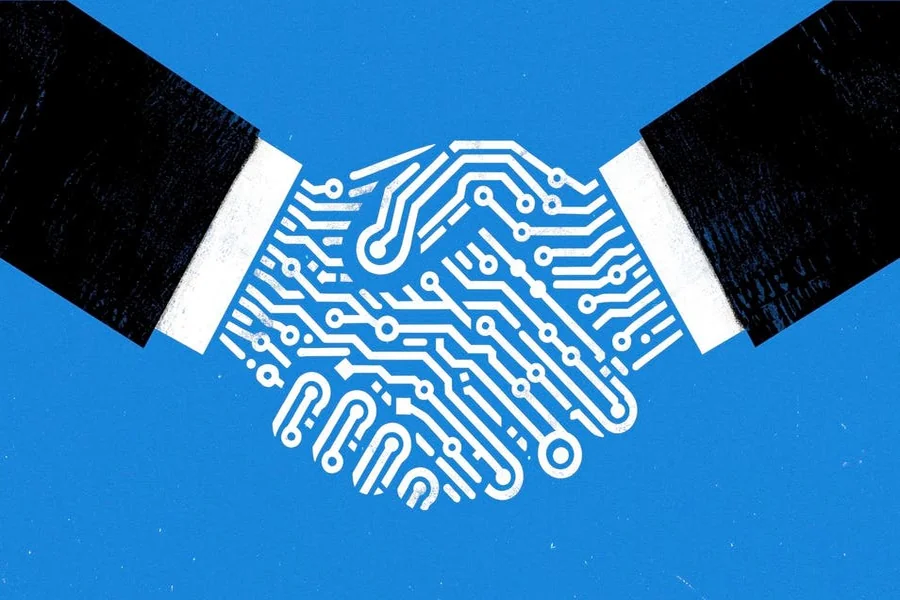
There are hardly any businesses that are truly independent these days. They rely on suppliers, distributors, associates, customers, and service providers. They differ in their methods, structure, and timings.
Artificial intelligence comes in handy here. Understanding the potential of AI to improve collaboration across business ecosystems can positively impact a leader’s time, error avoidance, and partnerships.
This guide explores the concept of a business ecosystem, the problems that arise when an ecosystem doesn’t work together, and where AI can help. It provides information on some risks and a quick start to start.
How AI Improves Collaboration Across Business Ecosystems
The solution to how AI improves collaboration across business ecosystems is to connect people, data, and systems. AI tools share knowledge with partners, streamline typical handoffs, convert between formats, predict problems and issues early, and deliver relevant information at the right time. This reduces delays and confusion and also gives partners access to the same information to make informed decisions; it also gives teams the time to think more about strategy and less about manual coordination.
What Is a Business Ecosystem?
Business ecosystem: an ecosystem of organizations that create value together. It often includes:
- Suppliers and manufacturers
- Logistics and delivery partners
- Technology vendors
- Resellers and channel partners
- The customer and the service provider
Members depend on each other but do not have a common system or a common feeling of “the truth.” The vast majority of collaboration challenges begin there.
Why Collaboration Breaks Down in Business Networks
It’s easier to know the common problems before you start considering solutions.
Data silos. No data is shared; it’s stored separately by each partner. No one is aware of the entire situation.
Slow communication. Lots of time in-between questions and answers—due to emails, telephoning, and spreadsheets!
Inconsistent formats. One partner sends PDFs, another sends spreadsheets, and a third uses an API.
Limited visibility. A delay isn’t known to teams until it has caused some damage.
Trust gaps. When there are no reliable and shared data, partnanswers—duediscussion about what data is shared;
These all require a combination of AI and human oversight. It does provide teams with concrete solutions to lower each of them.
How AI Improves Collaboration Across Business Ecosystems: Key Ways
So, let’s go over the main areas where AI is assisting partner networks. What are the central areas in which AI is aiding partner networks?
1. The first is to tie data across a variety of sources together. The first is to connect data from a multitude of sources.
AI-powered integration tools can be used to read, clean, and match data. They can identify the meanings of the words “Qty,” “quantity,” or “units.” This allows for partners to have a shared view without having to all be on the same platform.
2. Automating Routine Handoffs
There are lots of partner activities which are repetitive in nature: ordering confirmations, invoice matching, status updates, status document checks, etc. An AI-driven workflow automation system automates these steps and notifies when there are exceptions. Persons then concentrate on problems that call for judgment.
3. Predicting Problems Early
Predictive analytics can uncover patterns that can help prevent late shipments, low inventory, and even late payments. It is important that partners are warned before any danger arises, because they can change their direction if it is discovered before they have already done so, instead of trying to change it afterwards.
4. Desire to improve the flow of language and teams.
Natural Language Processing (NLP) applications can provide a summary of an extended thread, translate messages, and convert meeting minutes into actions. This can be very useful if you have partner networks around the globe with people in different time zones and languages.
5. Faster, Better Decisions (Supporting)
AI can read data from various partners and give actionable recommendations. If everyone has the same understanding, the faster their decision-making goes and the less the differences are between them.
6. Visualizing Partner and Customer Experience
AI has the capacity to tailor knowledge to each job. A supplier reads the forecast, a logistics partner reads the changes in routes, and a sales partner reads the product availability. They are provided with what they need without them having to look for it.
AI Capabilities and Their Collaboration Benefits
The table below shows how common AI capabilities support ecosystem teamwork.
| AI Capability | What It Does | Collaboration Benefit |
| Machine learning | Finds patterns in shared data | Earlier warnings and better forecasts |
| Natural language processing | Reads, summarizes, and translates text | Clearer communication between teams |
| Workflow automation | Handles repeat tasks and approvals | Fewer delays and manual errors |
| Predictive analytics | Estimates future demand and risk | Joint planning with less guesswork |
| AI assistants and chatbots | Answers partner questions instantly | Faster support, available any time |
| Intelligent data matching | Aligns data from different systems | One shared view across partners |
Real-World Use Cases
Below are some examples of how AI enables collaboration within business ecosystems in various industries.
Chain of Supply and Production. Demand forecasting and inventory levels are communicated between the supplier and the manufacturer using AI. Production plans change in advance when there is a change in demand.
Retail and e-commerce. The retailer and brand can match the right price, inventory, and marketing with the help of AI. AI can help retailers and brands match up the right pricing, stock, and promotions. This will minimize the risk of leaving empty shelves and overstocking.
Healthcare networks. In the healthcare industry, hospitals, and labs, AI can streamline the process of document review and claim verification. In healthcare, hospitals, and labs, AI can automate the document review and claim verification process. Staff spend more time with patients and less time on paperwork, without compromising patient privacy.
Financial services. AI is assisting banks and fintech partners in detecting irregular transactions and verifying documents. AI is helping banks and fintech partners to identify unusual activity and document verification. Shared alerts enable partners to respond as a group.
Software/technological partners. Using AI tools, partners can find documentation, quickly resolve support cases, and get to know the product.
Key Benefits for Your Business
The value of AI on business ecosystems is easier to quantify when teams understand the benefits of AI for collaboration.
- Improved partner response times
- There are fewer errors in manual data entry.
- Improved visibility of the whole network.
- Lower coordination costs in the long term
- Improved trust by consistent and shared data
- Increased time for strategy, automating routine work.
Before and After: A Simple Comparison
| Area | Without AI | With AI |
| Data sharing | Manual files and email | Automated, connected data flows |
| Issue detection | After a problem occurs | Early alerts before impact |
| Partner support | Business hours only | Instant answers, any time |
| Reporting | Slow and inconsistent | Near real-time and unified |
| Decision making | Based on partial data | Based on shared insights |
Challenges to Plan For
AI can be beneficial but should be used with caution.
Security of data and information. Partners will need to determine who should have access to the information and what information should be shared. A clear contract and clear control are important.
Data quality. The quality of the information given to the AI will determine its quality of performance. Bad data = Bad suggestions.
Trust and transparency. The results produced by AI may not be trusted by partners if they don’t understand it. Explainable results help.
Change management. There’s a learning curve and adjustment period for people. Teams that don’t see the value, new tools fail.
Integration effort. Older systems may need to be connected, and a plan and budget must be developed to facilitate it.
How to Get Started
No need to have a large project. It is best to have them start with a focus.
- Pick one problem. Choose a pain point such as late order notifications or slow invoice matching.
- Draw your partners, and map your data. List the people involved, and between which people is there information exchange?
- Establish agreement on data rules. Define simple privacy, access, and quality criteria.
- Run a small pilot. Test by one or two trusted partners.
- Measure results. Monitor partner feedback, error, and response time.
- Expand gradually. Expand the number of partners / number of use cases as the pilot is successful.
Measurements also provide you an insight into how AI is improving business ecosystem collaboration within your own business—not the business out there.
Best Practices for Long-Term Success
- Choose tools that can be directly incorporated into existing systems.
- Transparently communicate with partners regarding AI usage.
- Regularly review and identify aspects of performance needing improvement and make the necessary corrections.
- Provide training for teams to feel comfortable with new tools.
Final Thoughts
Good partnerships are key advantages today. Companies that adapt better to changing markets are able to share and act upon information in a smooth way, quickly.
Making business ecosystems more collaborative is important, and knowing the advantages of AI can help clarify the issue for leaders. Link your data, automate repetitive tasks, anticipate problems early, and involve people in decisions.
Start with one problem and one trusted partner. Test, learn, and develop. This coherent approach takes AI from the hype to a tool to enhance, strengthen, and inspire trust in collaboration.
FAQs
What are AI’s advantages for collaboration in business ecosystems?
AI combines data from a multitude of partners, automates repetitive tasks, predicts problems, and delivers information and insights on the fly. This enables everyone to be on the same page and react more quickly to changes.
How would you describe a business ecosystem?
A sequence of companies that need to provide each other with goods or services. These may be suppliers, distributors, technology vendors, and customers.
What are some of the most valuable benefits of AI collaboration tools for small businesses?
Yes. There are numerous AI tools available as low-cost cloud services. Small companies can start by adopting a single use case, like a chatbot to assist their partners with questions or a system to automatically update orders.
Is it possible to safely share data with partners through AI systems?
It can be, if necessary precautions are taken. Apply access control measures and encryption, and comply to industry privacy regulations for sharing data.
Which is the biggest hurdle in the application of AI in a partner network?
It’s typically the data quality and trust that are the toughest. It’s important that partners have the same information and a sense of security about how shared information can be accessed and used fairly and securely.
What is the time frame for results?
Depends on the size. Small projects can be improved in weeks or months; larger projects in longer time periods. Doing small things gives more immediate feedback.