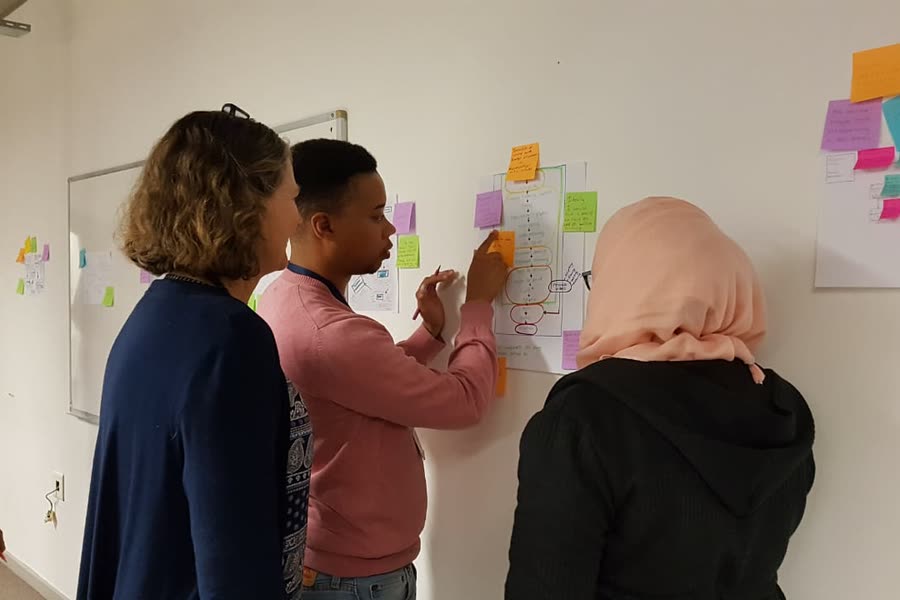
All teams have idea management. Very few teams have a great knack for dealing with them. Meeting discussions are shared, chat is shared, email is shared, and ideas are shared.
Idea management remedies this. It provides a place for each idea, an owner, and a next step.
This guide addresses what it is, how it works, and how to get started. It’s suitable for businesses, groups, and individual creators.
Related reading: idea generation, innovation brainstorming and innovation processes.
What Is Idea Management?
Idea management involves gathering, structuring, reviewing, and implementing ideas from staff, customers, or your own brain. It provides focus on all ideas from the initial concept to the final decision. With good idea management, teams can prevent themselves from losing good ideas and from selecting the best ideas while at the same time managing the time and money available. Typically, it involves 5 steps: capture, organize, evaluate, test, and launch each idea.

It is actually a repeatable system of innovation, in the simplest terms. It includes idea generation, capturing ideas, evaluating ideas, and implementing ideas. Imagine a pipeline: raw ideas are fed in, and tested and useful projects are fed out.
Why Idea Management Matters
Good thoughts go to their grave without a funeral. Individuals also cease to share when they don’t get a response.
A simple system that is beneficial:
- Fewer lost ideas. All suggestions are stored in one location.
- Better decisions. The ideas are compared according to the same rules, not according to people’s feelings.
- Higher engagement. Visions and actions are more likely to be shared when they are accompanied by feedback.
- Less duplicate work. Teams are able to observe the previously suggested or attempted work.
- Clear ownership. There is a person assigned for each idea as to what to do next.
Who Can Use This System?
- It’s not just for big businesses.
- It is used for businesses to collect the ideas of employees and customers.
- It is used to influence product teams to create roadmaps and new products.
- It is also utilized in schools and by nonprofits to enhance their programs on tight budgets.
- It is used by solo creators to maintain their writing, design, or business ideas.
The 5-Step Idea Management Process
The general flow of most systems is similar. Modify the information for your team.
Step 1: Capture Every Idea
Provide an easy way to submit an idea. Use one shared space (such as an online form, idea board, or tool).
Request three things: a brief name, a concise description, and what the idea addresses. Make the form short; otherwise, people won’t do it.
Step 2: Organize and Tag
Organize similar ideas in groups by theme, goal, or department. Merge duplicates and add tags for easy search. Tidy and searchable records are essential for good idea management.
Step 3: Evaluate and Score
Review ideas against clear criteria. The table below shows a simple scoring model. Rate each factor from 1 to 5, then compare totals.
|
Criteria |
Question to Ask |
Score (1–5) |
|
Impact |
How much value could this create? |
5 = very high |
|
Effort |
How hard is it to build or run? |
5 = very easy |
|
Cost |
Can we afford it now? |
5 = very low cost |
|
Strategic fit |
Does it match our goals? |
5 = strong match |
|
Risk |
What could go wrong? |
5 = very low risk |
Keep the model light. Three to five criteria are enough. You can give more weight to the factors that matter most to your goals.
Step 4: Test Before You Commit.
Conduct a micro-pilot, prototype, or test with select users. A quick test is a way to determine if an idea is effective before investing time or money.
Step 5: Launch, measure, and provide feedback
Set an owner and a deadline. Follow up on their success or failure on one or two of the following.
Next, let the other person who shared an idea know what happened (including if the answer is no). This feedback loop fosters trust and can inspire additional ideas.
Idea Management Software vs. Spreadsheets
You do not need special software to begin. A shared spreadsheet works for small groups. As ideas pile up, a dedicated idea management tool may save time.
|
Feature |
Spreadsheet or Notes |
Dedicated Tool |
|
Setup |
Fast and free to start |
Needs setup and a plan |
|
Collaboration |
Basic sharing and comments |
Voting, comments, and alerts |
|
Scoring |
Manual formulas |
Built-in scoring models |
|
Status tracking |
Manual updates |
Visual stages and workflows |
|
Search and tags |
Limited |
Usually stronger |
|
Best for |
Small teams, early testing |
Larger teams, high idea volume |
When you compare tools, look for easy submission, voting, comments, status tracking, and simple reports. Pick the lightest option your team will actually use.
Common Idea Management Mistakes
- Listening but not responding.
- Scoring too many times, using too many criteria.
- Allowing just senior leaders to rate ideas.
- Skipping an owner, so nothing moves forward.
- Attempting to do too much at once.
Every error is a loss of goodwill. Early patching maintains system trust.
Best Practices for Effective Idea Management
Good idea management is not a single occurrence but a habit. It can be made to last by these practices:
- Begin with a well-defined challenge. Closed questions, such as “How can we reduce onboarding time?” yield better ideas than open questions.
- Assign a time frame to respond. Give the child feedback within a specific time frame (e.g., within 2 weeks) and deliver it.
- Use diverse reviewers. Each of us has our own unique perspective on identifying risks and opportunities.
- Regularly review the backlog. What did not work last quarter may be a great idea today.
- Recognize effort. Acknowledge others for sharing—not just when their idea is successful!
- Share results. Provide examples of ideas that were launched and what they accomplished.
Idea Management for Solo Creators
The steps can be used independently. Maintain two “idea inboxes” in notes app, and place all ideas in one without delay.
Check the list once a week. Eliminate bad ideas, mark good ideas, and choose one to try. If you think hours, you will know less than a small experiment like a draft post or a mock design.
Final Thoughts
Great ideas are common. Ideas are common. Follow-through is a rarity. Strong idea management addresses that with a fair chance being provided to every idea and every contributor receiving a clear answer.
Start small. Select a single location for ideas, establish a basic scoring system, and designate an individual to own each successive action. Be open and transparent with the results and let others know they are valued.
Over the years it will foster trust, conserve effort, and make your best ideas a reality.
FAQs
What is idea management in simple words?
It is the process of gathering, classifying, evaluating, and reacting to ideas to prevent loss. It brings abstract concepts into concrete projects and decisions.
What are the main steps of the process?
The main ones are capture, organize, evaluate, test, and launch. Many teams include a final review for learning from outcomes.
Do small teams need special software?
No. At the beginning, it’s just a shared spreadsheet or board. Use a special tool for ideas that get lost or for several people to vote and comment.
How do you choose which ideas to pursue?
Apply a short model with clear criteria (impact, effort, cost, and fit with goals). Do a small test of the top ideas before going whole hog.
How is idea management different from brainstorming?
Brainstorming creates ideas. Idea management begins after brainstorming ends. It remembers, ranks, tests, and provides those ideas, and it records the effect.
How often should ideas be reviewed?
Most teams find monthly to be a good time frame. Teams can do a weekly review, or smaller teams can opt for a review every quarter.