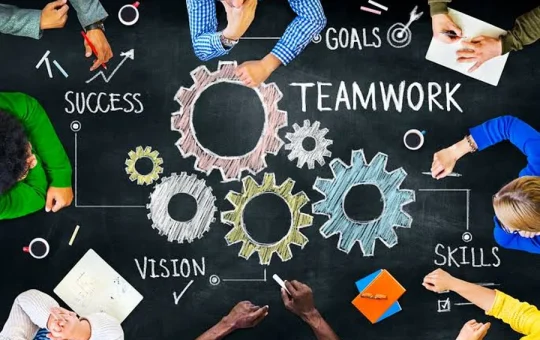
The doors can be opened with the help of C’s and technical expertise. Communication, team work and empathy, hold those doors open. They are soft skills and they are developed by working with other individuals.
Therefore, the effectiveness of learning together. This guide offers steps, activities and tips for classroom, training room and remote co-location teams to learn and improve soft skills together.
Small groups, a shared objective and clear roles are all required to develop soft skills through collaborative learning. Invite students to discuss ideas, debate and discuss problems as a group. Add in the regular reflection and peer feedback. Skills of communication, working in a team, empathy and problem solving are formed over time. It’s all about practice, practice, practice, and making note of what works in order for each group project to be a true opportunity to grow.
What Is Collaborative Learning?
Collaborative learning is learning in small group to a common goal. Learners share ideas, discuss and problem solve as a group not as individuals.
It is not the same as group work. It is when they depend on each other that collaboration is truly in evidence. All have a role and the finished product depends on everyone.
Why Collaborative Learning Builds Soft Skills Better Than Solo Study
There is no easy way to learn the transfer of soft skills from a book. Active listening can’t be learned in isolation from the act of listening. You find it out when you hear someone with a different perspective.
- People have a safe environment for group learning. They make few errors, get feedback and correct their efforts. That is a cycle that forms true habits.
- The main advantage of collaborative learning as the soft skill development is that it is based on skills practice in real context and not in theory. Some of the common social skills that have been learned this way are:
- Communication and listening skills.
- Teamwork and cooperation
- Leadership and responsibility
- Empathize with and respect other perspectives.
- Conflict resolution
- Time management
- Problem solving and critical thinking skills
How to Develop Soft Skills Through Collaborative Learning: 7 Steps
The following are the steps to take for group work to be a skill practice.
1.Establish a clearly-defined group objective
There needs to be a shared answer in each group. It could be a presentation, solution to a case or a written plan.
Specific goals give a rationale for members to work together. If it’s not there, then they get distracted by the side conversations or work on their own.
2. Assign Rotating Roles
Distribution of roles: Facilitator, Note taker, Timekeeper, Speaker, Reviewer. Rotate the tasks to make them different.
The key to rotation is the opportunity for a shy student to be in charge and a natural leader to be in charge. All people use a different skill.
3. Teach the Skill, before the Task
Never assume that learners have the knowledge of the collaboration. Practice spending 5 minutes on one skill prior to the activity.
For instance, have students repeat what their listening partner said before responding. Explain how to develop soft skills in terms of collaborative learning and remind them of the importance of the habits not the topic and provide simple sentence starters such as “I understand your point, and I would add….”
4. Keep Groups Small
The usual team is a group of 3-5 players. There is no one silent, anyone can speak.
In group situations larger groups allow a few people to talk. The small groups are virtually bound to require group participation.
5. Use Structured Discussion
Open discussion can lend itself to loud voices. Everyone gets a chance to take their turn when they have a structure.
Use the following basic styles:
- Think, Pair and Share: think independently, talk to a pair of people, share with the class
- Round robin: All take one turn, no one takes a second turn
- Jigsaw: every participant masters one part, elaborates it with the other participants
6. Add Peer Feedback
Feedback is the quickest avenue for development of soft skills. On completion of the task, ask the learners to give each other one strength and one suggestion.
Guide them to be more specific and considerate. “You made sure that everyone had a turn” helps more than “Good job.”
7. End With Reflection
Reflection can be a tool to transform an experience into a learning. After each activity ask short questions:
- What was a good thing I did as part of a team?
- What did you feel was difficult in the group?
- How will I change up my approach to this next time?
Students will benefit from seeing their own growth, even with 2-3 sentences, in written responses.
Collaborative Learning Activities That Build Specific Soft Skills
Different activities train different skills. Use this table to match the activity to your goal.
| Activity | Main Soft Skill | How It Works |
| Think-pair-share | Active listening | Learners think alone, discuss with a partner, then share with the group |
| Jigsaw method | Communication and responsibility | Each member masters one topic and teaches it to others |
| Group case study | Problem-solving and critical thinking | Teams analyze a real or realistic problem and propose a solution |
| Peer review circles | Giving and receiving feedback | Members review each other’s work using a simple checklist |
| Role-play | Empathy and conflict resolution | Learners act out workplace or classroom situations from different viewpoints |
| Group project with rotating leader | Leadership and time management | Each member leads one stage of the project |
Pick one skill at a time. This keeps the focus clear and makes how to develop soft skills through collaborative learning easier to track.
Common Challenges and How to Fix Them
Group work does not always go smoothly. Here are the most frequent problems and simple fixes.
| Challenge | Why It Happens | Practical Fix |
| One person does most of the work | Roles are unclear | Assign roles and ask for individual contributions |
| Quiet members stay silent | Shyness or fear of mistakes | Start with pair talk, then move to the group |
| Disagreements turn into arguments | No shared ground rules | Set rules for respectful disagreement before starting |
| Groups go off-topic | No time limits | Use a timekeeper and short checkpoints |
Challenges are normal, and they are part of the lesson. Handling a difficult teammate is a soft skill exercise in itself. Learners exploring how to develop soft skills through collaborative learning should treat these problems as practice, not failure.
Tips for Teachers, Trainers, and Team Leaders
As a group leader, your choices make a difference for your group. Here are some tips to remember:
- Model the behavior. Show polite disagreement and listening skills.
- Mix the groups. Rotate members of group often, so that pupils are exposed to different personalities.
- Assign jobs which need all. If someone can do it all on their own, it will not be a collaboration.
- Step back. Give groups some small problems to solve; do not intervene.
- Praise process and not results. Be sure to praise group effort and right answers!
Keep in mind that the key to learning soft skills is related primarily to good task design when it comes to collaborative learning. The correct structure will do the majority of the teaching.
How to Track Progress
Unlike hard skills, soft skills cannot be measured but they can be observed. Concentrate on behavior rather than personality.
Useful tools include:
- Rubrics that have 3 levels, such as beginning, developing, strong
- Peer feedback forms
- Self-assessment journals
- Short notes for teachers/manager for observation
Ask clear questions. Have others been invited to speak by the learner? Were their feedback well received? Did they do their part/call on time?
Check the results periodically, e.g., once or twice a week. It will make it possible to measure the development of soft skills in collaborative learning, making it fair and provide evidence of learning progress.
Collaborative Learning in Online and Remote Settings
It’s the same as what they do on the Internet. Breakout rooms, documents and group chats can be used instead of the physical table.
For remote groups, there are a number of supports that must be added. Set communication rules, expectations and identify roles clearly for all. The methods of building the soft skills in collaborative learning in virtual learning environment are similar to that in face-to-face learning: starting with a common purpose, identifying the roles, designing a conversation, and providing feedback.
Final Thoughts
Soft skills are not innate skills you have. These are both habits and, of course, habits can be cultivated with practice, feedback, and reflection.
This is the main reason, which makes the question How to Develop Soft Skills Through Collaborative Learning useful for teachers, trainers and learners. Groups give a space for people to listen, have a voice and lead, and solve problems in real situations.
Make gradual steps. For your next group task, add roles, or as a part of your next session, end with 2 minutes to reflect. Say it and say it and say it, and it shall come back. Learning together is more than a knowledge transfer. It helps people to learn to work co-operatively—the skill remains long after the lesson.
FAQs
How to learn to develop soft skills by collaborative learning?
Start small. Work as a team (3-5 students) and go through each of the soft skills as a team, giving each person a role to play in the process. Provide feedback and reflection for each task.
What are the most successful soft skills that can be enhanced from group learning?
Typically, those skills that are most helpful for communication, teamwork, empathy, leadership, and conflict resolution. These skills need to be practiced and groupwork provides for this.
How much is the optimum group size?
Most of the tasks can be performed by 3-5 members. The size of the group provides enough for people to contribute to the group and share ideas that can be brought up within the group.
Can “collaborative learning” be done online?
Yes. Educate participants on how to use Breakout Room, documents shared, and well-defined roles. There are more rules for communicating for online groups, but the learning is the same.
What is the time frame for results?
This depends on the needs of the individual and/or group. Most learn by practicing, feedback and reflection. Regular practice with a few weeks of intervention, many learners report minute improvements in their confidence and listening skills.
Does this only work for students?
Children aren’t the only ones who can use this, however, adults or employees/teams can use it as well! The same tools are employed in the workplace training, mentoring groups and project teams.