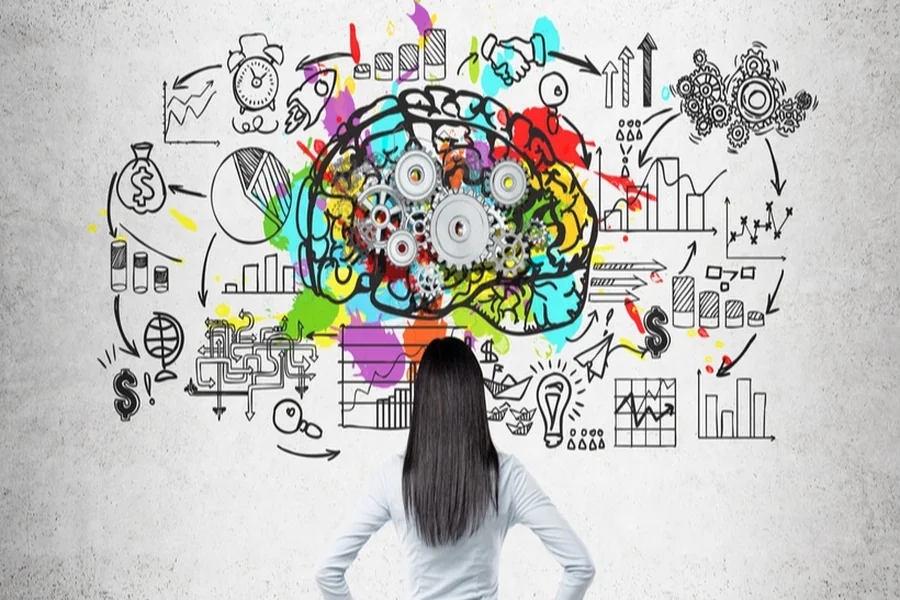
Process of creativity and innovation is the process to transform a spark of imagination into reality and actual usage. People believe that their great ideas come out of nowhere. Actually, these are habits, methods, and perseverance.
It describes each and every stage, demonstrates how the stages link together and provides you with some tips that you can apply today.
What Is the Process of Creativity and Innovation?
Creativity and innovation are a set of steps to take an idea from the initial to the actual value. Involves identifying the problem, getting information, brainstorming ideas, testing the ideas, and implementing the best idea. Creativity produces the idea, and innovation is the implementation of the idea.
Creativity vs. Innovation
These two words are linked but not identical.
| Feature | Creativity | Innovation |
| Focus | Generating new ideas | Applying ideas to create value |
| Output | Concepts, sketches, possibilities | Products, services, improved methods |
| Success measure | Originality | Real-world impact |
| Risk | Low | Higher, as there are resources involved. |
Creativity is the basis for innovation; without it, there is nothing to build on. Innovation is required to make creativity a reality.
Why the Process of Creativity and Innovation Matters
Groups that work through a creative, innovative process use less time. They also steer clear of the most common pitfalls of not following up on ideas that no one is interested in.
- With a structure you can:
- Use new approaches to solve problems
- Be prepared to remain competitive in changing markets.
- Minimize risk of failing projects.
- Create an environment in which the sharing of ideas is encouraged.
The Main Stages of the Process of Creativity and Innovation
Creative thinking has been defined in various ways. One of the most recognized four-stage models is that of Graham Wallas, who described these four stages as preparation, incubation, illumination, and verification. Steps for testing and launch are added to modern innovation work. The framework below blends both views.
Stage 1: The problem and/or opportunity are clearly defined.
The problem and/or opportunity is clearly presented.
All good ideas begin with a problem. Questions that will help you identify the people who are struggling, what’s frustrating them, and what is missing.
Good questions are as follows, followed by good ideas. Fuzzy problem + fuzzy solutions.
Stage 2: Prepare and Gather Information.
Afterwards, read about the topic. Study, observe, and review the competition. This is the foundation for your creative thinking brain.
The following are useful methods: customer interviews, market research, and learning from previous failures.
Stage 3: Activity: Incubate Your Thinking
But sometimes the best way to do something is to take a break. When you walk, rest, or work on something else, your mind is able to come up with associations in the background. Many say it is during this peaceful time that answers come to them.
Stage 4: Generate Ideas
Now make as many suggestions as possible! Now, it’s about the quantity; quality follows.
Common techniques include:
Brainstorming: Generating ideas without evaluating them.
Make use of mind mapping: Link up related thoughts in a viscerally connected manner.
SCAMPER: Substitute (parts of an idea), Combine (parts of an idea), Adapt (parts of an idea), Modify (parts of an idea), Put to another use (parts of an idea), Eliminate (parts of an idea), and Reverse (parts of an idea) from an existing idea.
Analogies: Take ideas from other areas.
Stage 5: Evaluate and Select
Look back at your list and select the best ideas. Evaluate each one on the basis of the criteria that are well understood, such as customer value, cost, and ease of construction.
It’s time for students to prototype and test!
Stage 6: Construct a basic prototype of your concept
A sketch, model, or simple working model is fine. Give to genuine testers and listen to their input.
It is more cost-effective to test early than to fix problems after launch. In addition, it is where creative ideas and innovation become a reality.
Stage 7: Implement and Launch
If the test is successful, outline a plan for the full rollout. Set goals, divide tasks, and arrange materials. Next, implement the product/service/process change.
Stage 8: Review and Improve
Track and evaluate performance after the launch. There is always more to innovation than the release. There are lots of products that are successful that are constantly evolving due to user feedback.
Process of Creativity and Innovation at a Glance
| Stage | Main Goal | Example Tool |
| Identify | Define the real problem. | User interviews |
| Prepare | Build knowledge | Market research |
| Incubate | Let ideas develop. | Rest, breaks |
| Generate | Create many options. | Brainstorming |
| Evaluate | Pick the best idea. | Scoring matrix |
| Prototype | Test cheaply. | Mock-ups |
| Implement | Launch | Project plan |
| Review | Improve | Feedback analysis |
Common Barriers to Creativity and Innovation
Any great creative and innovative process can stall. Look out for these blocks:
- Fear of failure: ideas are concealed when they are thought of as being weak.
- Fixed routines: Little opportunity for experimentation if routines are fixed.
- No time: Busy schedule reduces thinking time.
- Little feedback: Excessive or ambiguous feedback will discourage sharing.
Tips to Strengthen Your Creative and Innovation Process
- Make time and space for reflection.
- Accept different opinions.
- Don’t consider a failed test a defeat, but a lesson.
- Have an idea book or computer file for ideas.
- Repeat “what if . . . ?” questions, over and over again.
Final Thoughts
Process of creativity and innovation is not just for artists and inventors! It is a redoable route that can be done by anyone or a group. Take a real problem and brainstorm lots of ideas, quickly test some of them, and iterate.
Keep in mind that just ideas don’t change much. Value is when you do something with them. Select one problem today, try out the first 3 steps, and go with the flow of the creative and innovative process.
FAQs
1. What is the process of creativity and innovation in simple words?
It is the road from the idea to the “useful. It also contains locating the problem, generating concepts, testing them, and launching the best one.
2. How many steps are in the process of creativity and innovation?
No definite number exists. There are four stages, as said by the Walhas, but there are 5 to 8 stages in modern models. The following information is based on the use of eight.
3. What is the difference between creativity and innovation?
Creativity is the product of original ideas. Innovation is expressing those thoughts in a way that is useful to others.
4. Can anyone learn the process of creativity and innovation?
Yes. Creative thinking can be taught, nurtured, and practiced with curiosity and the proper technique.
5. Why is testing important?
Testing reveals if people are interested in your idea. It aids you in solving issues before you have to put in a lot of money.
6. What tools support the process of creativity and innovation?
Brainstorming, mind maps, SCAMPER, design thinking, and prototyping are all common tools.
7. How long does the process take?
This will vary according to the project. New product development can take months or years, and a small improvement can take days.
8. Does innovation always require new technology?
No. Innovation can be a better service, a smarter workflow, or a new business model.