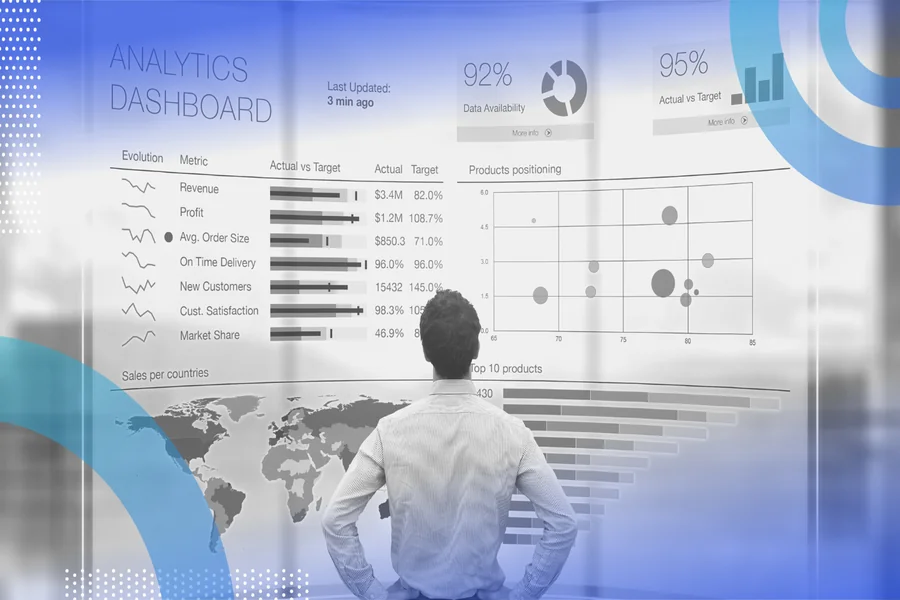
As far as application of analytics, it’s the use of data to make better decisions. Today, analytics is applied to real-life problems in business, healthcare, schools, and government. This guide provides an overview of how analytics can be used in various industry scenarios and demonstrates with examples.
What Is the Application of Analytics?
Application of Analytics: Using data analysis to find patterns, make predictions, and make decisions based on the data. It’s adopted by organizations in marketing, finance, healthcare, operations, and other sectors that wish to save on costs, reduce risk, improve the customer experience, and leverage data instead of assumptions to uncover new opportunities.
All uses of analytics begin with a question. Data collection, data cleansing, and data analysis. The outcome is a choice or act.
Four Types Behind Every Application of Analytics
| Type | Question It Answers | Example |
| Descriptive | What happened? | Monthly sales report |
| Diagnostic | Why did it happen? | Finding why customers left |
| Predictive | What will happen? | Demand forecasting |
| Prescriptive | What should we do? | Route optimization |
Typically these are combined into a single group. Analytics are best used in the prescription.
Application of Analytics in Key Industries
We will learn about analytics and how to use them in business and marketing. Use of analytics in business and marketing will be discussed.
Analytics used in marketing demonstrates which marketing campaign generates actual customers. Teams leverage customer segmentation, A/B testing, and attribution models. Analytics applications increase ad spend and customer loyalty.
Advanced Analytics for Healthcare. What is analytics being used for in healthcare?
Analytics in healthcare can be used for patient risk scoring, scheduling, and resource planning. Record checks are done at hospitals to identify patients that might require a timely intervention. This use of analytics enables staff to make their decisions earlier.
Using Analytics for Financial Purposes. Financial Analytics Applications
Banks use analytics for fraud detection and for credit scoring. Any unusual transaction is detected while happening. One example of how analytics has been used to manage risk and report on compliance.
Application of analytics in the retail/supply chain industry. Retail and supply chain analytics
For retailers, the application of analytics for demand forecasting, pricing, and inventory management. It is utilized in the supply chain for route planning and to reduce delays. This analytics use minimizes waste and out-of-stock.
There are a number of ways that analytics can be used in education and government. There are multiple applications of analytics in education and government.
Pupils’ progress is monitored by the school to ensure that any pupil struggling is supported. Cities analyze traffic and service information to make decisions about traffic and service planning. Both use analytics to turn the data into actionable insights.
Let’s take a quick look at each of the analytics applications by industry:
| Industry | Common Use | Main Benefit |
| Marketing | Segmentation, attribution | Better return on spend |
| Healthcare | Risk scoring, scheduling | Earlier care |
| Finance | Fraud detection, credit scoring | Lower risk |
| Retail | Forecasting, pricing | Less waste |
| Education | Performance tracking | Targeted support |
Benefits of the Application of Analytics
- Faster, fact-based decisions
- Save money and cut down on waste.
- Enhanced up-to-date understanding of customers. Improved knowledge about customers.
- Having early warning of risk
- Clear performance tracking
The greater the degree of good data quality, the more benefits could derive from the use of analytics.
How to Start the Application of Analytics Step by Step
- State 1 a clear business question.
- Collect relevant, pertinent data.
- Select simple tools like spreadsheets, SQL, and dashboards.
- Experiment with your idea on a small project.
- Report and make changes.
A small pilot makes the use of analytics less complicated for backup and growth.
Common Tools for the Application of Analytics
Typical tools that teams can be using include Excel, SQL, Python, R, Tableau, and Power BI. Depending on the skills, budget, and data size, the most suitable tool will be decided. Any use of analytics is more effective in the context where the tool fits the question.
Challenges in the Application of Analytics
Poor data quality is the No. 1 problem. Other factors include a lack of skills, privacy policies, and poor team support. Analyze for bias in data sources and protect personal data. Plan for these early to ensure it is a factual and honest analytics application.
Future of the Application of Analytics
Application of analytics is becoming quicker and simpler than before, thanks to automation and AI. Real-time dashboards and predictive models have become the norm. However, human judgement is required since people are compelled to doubt outcomes and make decisions.
Final Thoughts
It isn’t even a question this day for teams when it comes to application of analytics. Simplify; use simple data and one question at a time. Once practiced, the use of analytics can be an effective edge that continues to help business. Begin with just one data and one goal to jumpstart an analytics application.
FAQs:
What is the application of analytics?
It means using data to answer questions and guide decisions in real work.
Why is the application of analytics important?
It replaces guesswork with evidence, which saves time and money.
What are examples of the application of analytics?
Fraud detection, demand forecasting, patient risk scoring, and campaign testing.
Which industries use the application of analytics most?
Finance, healthcare, retail, marketing, and logistics are leaders, but any data-rich field can benefit.
What types of analytics support the application of analytics?
Descriptive, diagnostic, predictive, and prescriptive analytics.
Can small businesses use the application of analytics?
Yes. Start with spreadsheets and sales data. Even a small application of analytics can show your best-selling products.
What skills help with the application of analytics?
Basic statistics, data cleaning, tool knowledge, and clear communication.
What is the biggest challenge in the application of analytics?
Poor data quality. Inaccurate data leads to weak decisions.