A product strategy workshop provides your team with a single place to determine focus and gain the win. Without it, teams create features that seem like they have a lot of merit on their own but aren’t corresponding to a larger goal.
This guide will help you plan and conduct a product strategy workshop that leads to decisions—not sticky notes.
What Is a Product Strategy Workshop?
Product Strategy Workshop is a focused meeting that brings together the shared vision, target customers, objectives, and priorities of the product, Design, Engineering, and business leaders. It normally takes half a day to two days. Participants apply techniques to transform ideas into a clear plan, like user research reviews, opportunity mapping and prioritization. This leads to a common strategy and a draft roadmap agreed to and supported by the entire team.
Related reading: our guides to product innovation strategy, the innovation roadmap and how to run an ideation workshop.
A product strategy workshop is different from a regular planning meeting in that it deals with the “why” of the process first and the “what” second. The problem and the customer are agreed upon first between the teams. They don’t discuss features until after they’ve finished talking about the product.
Why Run a Product Strategy Workshop?
There is sometimes one leader who has strategy in his head. A workshop takes it out of the dark room and puts it in the light room where all can test it, challenge it and commit to it.
- A product strategy workshop is a very effective workshop to help you:
- Identify and position players with divergent perspectives on priorities
- Limit expended effort on non-company efforts
- Identify surface risks and assumption early on before they become costly.
- Have the criteria agreed to beforehand to speed up decision-making.
- Involve owners, as the people who benefit from, support what they help to create
Product Strategy Workshop vs. Roadmap Planning
Teams often confuse the two. They are related, but they solve different problems.
For wider thinking on how companies set direction, see the strategy section at Harvard Business Review.
|
Area |
Product Strategy Workshop |
Roadmap Planning Session |
|
Main question |
Where are we going, and why? |
What will we build, and when? |
|
Focus |
Vision, customers, goals, bets |
Features, timelines, dependencies |
|
Time horizon |
Long term (often 1–3 years) |
Short to medium term |
|
Typical output |
Strategy statement, goals, priorities |
Prioritized roadmap |
|
Who attends |
Cross-functional leaders |
Product, engineering, delivery |
Run the strategy session first. A roadmap built without a clear strategy is just a list of requests.
Who Should Attend
Small groups typically make decisions quicker. Call in those who influence or are responsible for implementing the strategy.
- Product leader or product manager: is responsible for the results.
- Engineering lead: determines feasibility and effort.
- Design/UX lead: provides user insights
- Sales customer/Market & customer feedback: shares market and customer feedback
- The role of the executive sponsor is to establish business objectives and to eliminate obstacles.
- Advance organizer: ensures the material is clearly explained and organized
When to Hold a Product Strategy Workshop
You are not required to have them monthly. Apart from the obvious, here are some instances that call for a product strategy workshop:
- You are introducing a new product into the market or a new product category into your organization.
- You are growing team and priorities are not clear.
- You’re past your growth plateau and require a new direction.Growth has stalled and you need a new direction.
- New leadership or company objectives have emerged.
- You are beginning the annual or quarterly planning process.
How to Prepare
The effectiveness of your Product Strategy Workshop depends on good preparation. Most of the poor sessions never get to the start.
- Define the goal. Write 1 sentence on what the session should decide.
- Gather evidence. Gather customer feedback, usage information, sales information and competitor notes.
- Share a pre-read. Prepare an abbreviated summary two or three days in advance.
- Choose the format. Make sure to choose between face-to-face and online, and schedule adequate time.
- Set the rules. Decide how decisions are to be made, including consensus and/or a named decision maker.
Sample Product Strategy Workshop Agenda
This one-day outline works for many teams. Adjust the timing to your needs.
|
Session |
Time |
Goal |
|
Welcome and goals |
30 min |
Set context and ground rules |
|
Customer and problem review |
60 min |
Agree on who you serve and their key problems |
|
Vision and market position |
60 min |
Draft a clear vision and positioning |
|
Lunch break |
60 min |
Rest and informal discussion |
|
Opportunity mapping |
60 min |
List and group possible bets |
|
Prioritization |
60 min |
Rank opportunities with shared criteria |
|
Goals and success metrics |
45 min |
Link bets to measurable outcomes |
|
Next steps and owners |
30 min |
Assign actions and deadlines |
For a half-day product strategy workshop, combine the customer, vision, and opportunity sessions and shorten prioritization.
Popular Frameworks and Activities
Select two or three to include in product strategy workshop. Excessive numbers will impede the group.
JJB: What customers want to do
- Design thinking model: Value proposition canvas and matching customer needs with product benefits.Design thinking model: Value proposition canvas – matching customer needs with product benefits.
- The SWOT analysis is carried out to consider strengths and weaknesses as well as opportunities and threats.
- Opportunity solution tree: connects goals and opportunities/possible solutions
- Brainstorming: Generates ideas about the topic.Brainstorming: Generates ideas about the topic.
- RICE scoring: prioritizes ideas based on the four criteria, namely Reach, Impact, Confidence and Effort
- Customer value metric: a single metric that captures the most important aspect of customer value
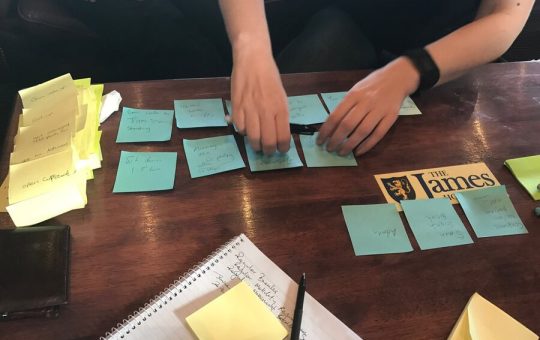
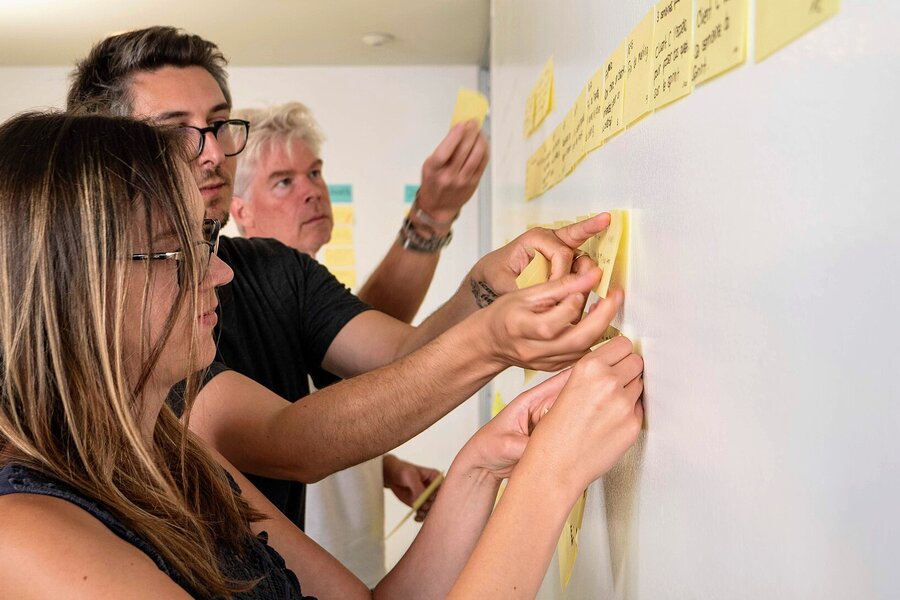
Quieter people can participate in brainstorming by creating sticky notes and then dot voting. It also dampens the impact of the loudest voice.
Facilitation Tips for Better Results
The neutral facilitator helps maintain a product strategy workshop’s flow. When both leading and participating, it is difficult to do both well.
- Always start with the customer, not the solution
- Limit all discussions to a maximum of five minutes – (apply a visible timer)
- Put aside miscellaneous thoughts in a “later” list
- Seek evidence when making a strong statement
- Record decisions in writing (as you go)
- Summarize at the end of each session
Running a Product Strategy Workshop Remotely
It’s possible to have a remote product strategy workshop, but it requires the right setup. Shared exercises can be conducted with online whiteboards like Miro or FigJam.
Make sessions shorter, 60-90 minutes at a time. Divide long agendas into two or three days. Ensure the use of breakout rooms for small group work and then reconvene for sharing.
Common Mistakes to Avoid
- Inviting too many people. Groups of many members decrease participation and delay decision making.
- Skipping the evidence. Information without interpretation is a poor basis for strategy.
- Jumping to features. Priorities and problems are followed by solutions.
- No clear decision-maker. One can be needed to avoid the debate from being dragged out.
- Ending without actions. If nobody is responsible for the next step, a good discussion is lost!
What to Do After the Workshop
The hard part begins after the product strategy workshop. Share them with the decisions, goals, priorities and owners within a week.
Next, put the results into practice:
- Transform priorities into a draft roadmap
- Set OKRs (Objectives and Key Results), to ensure measurable goals
- Check-in after 30-60 days.
- Revise the strategy as market conditions change.
Use the strategy as a work in progress. It should be used for making daily decisions, not just stored in a folder.
Final Thoughts
One of the most effective ways to coalesce the opinions into a plan is to have a product strategy workshop. It connects people, makes customer needs the priority and establishes priorities.
It doesn’t have to be a complex format. Plan with actual evidence, maintain focus, incorporate some of the key frameworks that have proven to be effective and conclude with Action/Take Owners and Next Steps.
Most importantly, view the results as the beginning of the task. Only a product strategy workshop is successful when the outcome impacts the next product that your team creates. Write it down, execute it and follow it up.
FAQs
How long should a product strategy workshop last?
The majority persist for 1/2 to 2 days. A half day format is appropriate for a focused topic or for a smaller group. For new products or major changes in product strategy a full day or 2 day product strategy workshop is better.
Who should facilitate a product strategy workshop?
A neutral person, who has no stake in the outcome. This may be a seasoned product coach, someone from a different team, or an outside facilitator. An impartial guide helps to maintain an equitable and on-topic conversation.
What are the main outputs of a product strategy workshop?
Common results are a product vision, a clear target customer, problems to be solved, strategic objectives, prioritized list of issues, success criteria, and action owners. A lot of teams go with a draft roadmap as well.
How often should we run one?
Many teams have a Product Strategy Workshop once a year and less frequent quarterly reviews. If there is any significant change, like a new market, a big competitor, a change in company goals, etc., conduct an additional session.
Can a small startup benefit from a product strategy workshop?
Yes. Startups often have limited time and resources, so clear priorities matter even more. A short, focused session can help a small team agree on its customer, its core problem, and its next few bets.
What is the difference between product strategy and a product roadmap?
Strategy explains where you are heading and why. A roadmap shows how and when you plan to get there. Strategy comes first, and the roadmap should follow from it.