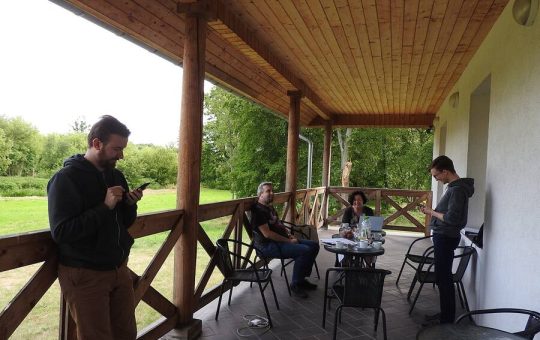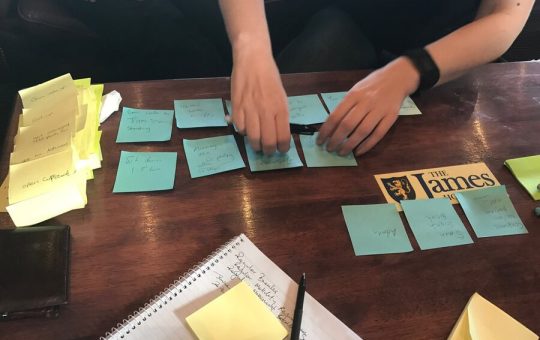
A business innovation workshop is an interactive process, guided by a clear business innovation workshop agenda, that a team goes through to find out the problem, brainstorm the solutions, choose the best ones, and test them out. Primarily it is usually for hours to several days and consists of the following steps: Defining the objective, researching consumers’ needs, brainstorming, prioritizing, and conducting several experiments. Not only is it a matter of new ideas, but it’s also a matter of a short list of ideas that have been tried with the owner(s) and a deadline.
Consider a business innovation workshop a work session and not a long meeting. They bring their notes with them and not only their decisions!
It is also different than a simple brainstorm. The list is generated from a brainstorm. A workshop is used to develop a plan.
For background, see our guides to the ideation workshop, a brainstorming workshop and product innovation strategy.
Why a Business Innovation Workshop Is Worth Your Time
There are four aspects of a well-run session that are helpful:
- Comprehends various perspectives. Sales, product, finance, and support: view the problem differently.
- It continues to be all about the customer. The need of the real customer is evaluated against ideas, not opinion in the office.
- It speeds up the decision-making process. Teams move from maybe to test it first—in hours, not months.
- It gives the sense of ownership of the community. People support ideas that they have helped to create.
It also helps to give more voice to the teams with less noisy members. Facilitated meetings show up ideas that wouldn’t be apparent in a regular meeting.
Common Types of Innovation Workshops
Not every business innovation workshop looks the same. Pick the format that fits your goal.
For current ideas on how companies innovate, see Forbes Innovation.
|
Workshop Type |
Best For |
Typical Length |
|
Problem-discovery workshop |
Understanding customer pain points |
Half a day |
|
Ideation workshop |
Creating new product or service ideas |
Half to one full day |
|
Business model workshop |
Testing how a new idea can earn money |
One to two days |
|
Design sprint |
Building and testing a prototype quickly |
Around five days |
|
Process improvement workshop |
Cutting waste and fixing slow workflows |
Half to one full day |
Lengths vary by team size and topic. Start small if your team is new to this kind of work.
Who Should Attend
The skill and opinions are a great asset when they are mixed in a business innovation workshop. Consider inviting:
- A decision-maker who is able to approve next steps.
- Staff who have regular contact with customers and who are listening to the complaints and requests made by customers.
- Knowledgeable in products/technologies and knows what is possible
- Finance/Operations are knowledgeable about cost and risk.
- A person coming with a fresh viewpoint from another firm or team
- A facilitator who has no emotional involvement and who helps to keep track of the time
Try to maintain a group of 6–12 people. If there are larger groups, divide into smaller teams.
Business Innovation Workshop Agenda: How to Plan and Run One
Preparation makes good results. Do these six steps.
STEP 1: The program is to set one solid goal.
Before booking a business innovation workshop, write one sentence that explains the purpose of your workshop. In the case of a subscription service, for example, “What can we do to reduce the number of customers leaving our business?
A clear goal is better than a fuzzy goal. Be more innovative—this is too open to interpretation.
STEP 2: Gather Customer Data.
Get information in advance of the session. Take surveys, support ticket notes, and sales call notes and brief conversations with customers.
Give participants a 1-page summary. This saves time and has a better focus.
Step 3: Select Your Format and Tools
Decide to hold the session in the classroom or online. Use simple tools like sticky notes, whiteboards, or a shared digital board.
Don’t get too complicated. The best tool is one that doesn’t require training for your team.
Step 4: Make an easy-to-follow agenda.
Below is a template for a 1-day business innovation workshop:
|
Time Block |
Activity |
Output |
|
Morning, part 1 |
Review the goal and customer insight. |
Shared understanding of the problem |
|
Morning, part 2 |
Define challenges with “How Might We” questions. |
A ranked list of challenges |
|
Midday |
Break and informal talk |
Fresh energy |
|
Afternoon, part 1 |
Idea generation in small groups |
20 or more raw ideas |
|
Afternoon, part 2 |
Vote and shortlist |
Top three ideas |
|
Late afternoon |
Plan quick experiments. |
Owners, tasks, and dates |
Adjust the timing to fit your group. Leave room for breaks, because tired teams think less clearly.
Step 5: Play the Session With Clear Rules
Establish guidelines at the beginning:
- Keep judgmentary feedback to a minimum when generating ideas.
- Go for the quantity first and quality second.
- Expand ideas of others.
- Avoid the use of cell phones and e-mail.
Facilitator’s role—time management and ensuring that all voices are heard. To avoid a few loud voices dominating the group discussion, give a few minutes of silent writing before the group discussion is held.
Step 6: Determine next steps and prioritize them.
Lost ideas are ideas without owners. Have a dot voting or basic impact/effort matrix to choose the best ideas before all the participants are gone.
Write the name of the owner(s) of the idea, the small test, and the date of the review for each selected idea.
Popular Techniques to Use During the Session
All of these are approaches that will be suitable to a business innovation workshop. All of them are not necessary.
- Design thinking: An iterative process of understanding and prototyping that is user-centered.
- How Might We questions: Short questions are used to transform a problem into an open question, for example, How might we make onboarding quicker?
- To prevent falling into the trap of getting on the same ruts, crazy 8s: Everyone writes 8 ideas in 8 minutes.
- SCAMPER is a checklist of ideas to suggest changes, replacements, and reversals to an idea.
- Jobs to be Done: You can use a method that understands what is the “job” that a customer is paying you to do with your product to get it done.
- Business Model Canvas: A one-page map of the business model for customers, value, channels, cost, and income.
- Dot voting: A simple way of narrowing down many ideas to a few.
Select 2-3 techniques that are congruent with your objective. A few tools that are used well are more powerful than many used badly.
In-Person vs. Virtual Workshops
A virtual business innovation workshop is a great idea, especially if you’re working remotely from other people. With a little bit more organization, it would be nice.
- Make the sessions shorter and divide them into two or three days, if necessary.
- Have a common digital whiteboard to share ideas simultaneously.
- Consider using breakout rooms for small-group work.
- Get screen breaks.
Personal interactions help to interpret the room and help to alleviate customer apprehensions. Online sessions also save time that would otherwise be spent traveling and allow for teammates to be remote. Make a selection that is appropriate for your team and not merely for the trend.
Common Mistakes to Avoid
There are issues that come back. Watch for these:
- No clear goal. The group strolls and walks without a destination in mind.
- The wrong people at the wrong place and time. Ideas become dormant when no one approves to do something about them.
- Many concepts and no filtering. Long lists are like work and they don’t do anything.
- No follow-up. Without further action by anyone, energy quickly drains away in days.
- Ignoring customer data. Ideas that are out of reach because of the opinions of those who put them forward.
The answer is quite simple—prepare, ensure the right people are there, and plan ahead for what comes next.
How to Measure the Results
The benefits of a business innovation workshop shine through post-workshop as opposed to during the workshop. Note a few simple indications:
- Experiments went to the test: How many of the shortlisted ideas were tested?
- The speed of the team’s idea to first test development.
- Did there have been any customer responses as a result of tests showing real interest or improvement?
- Team feedback: Did the session help and clarify for participants?
The business impact: Over time, was the concept that you developed successful in a desired aspect of your business, either in revenue, savings, or customer satisfaction?
The results of these will be reviewed in 30 – 90 days following the session. Share with everyone what worked well and what didn’t in this lesson, then apply this feedback to improve the next lesson.
Should You Hire a Facilitator?
The outside facilitator has experience and is impartial. They will be able to deal with difficult group dynamics and stay on track with the session.
A facilitator from within will be less expensive and will be familiar with the company. They may, however, not be able to maintain objectivity when they are also interested in the topic.
Many teams feel it’s worth their while for the initial session when they’re trying to achieve a significant goal to have a more experienced facilitator guide the process. For regular sessions, training can be done in-house.
Final Thoughts
There is nothing special or unique about a good idea. Good ideas are not uncommon. Good ideas are common. Epic ideas are common. Lack of clarity of action. A business innovation workshop provides you with a common process to get your team from one to the other.
Work toward one goal at a time. Call on the proper cast of characters. To begin with customer facts, then brevity, and end with owners and dates.
Then follow through. The actual return will be the little experiments you will carry out during the next few weeks following the session.
If you feel like you’re in a rut with your team, make it a quick session this month. One focus day can change the thinking and working of your team.
FAQs
How long should a business innovation workshop last?
This will vary based on the objective. A problem-solving session that is focused can take up to half a day. Prototyping can take 1-7 days, if necessary. Often the shorter and more focused sessions will be more effective than the longer and unfocused ones.
How many people should join?
This would be 6-12 units. This is big enough to offer different perspectives and small enough to allow everyone to participate. Use small break out teams for larger groups.
What should we prepare before the workshop?
Develop a precise goal, customer insight summary, agenda, and participants list. Make a reservation and/or create an online board ahead of time.
What happens after the workshop ends?
The team should carry out small experiments on the best ideas. Set owners, set review dates, and report results. If this is not taken, the value of the workshop is short-lived.
Can small businesses benefit from this type of session?
Yes. An inexpensive session of a few people working on the white board with sticky notes. No, it’s not about the cost; it’s about the method.
What is the difference between a brainstorm and an innovation workshop?
Brainstorm is a session that is meant for generating ideas. The innovation workshop will consist of problem definition, customer insight, prioritisation and action plan. It is intended for decision making.