Design thinking for business innovation is a problem-solving approach that starts with the people who use a product or service. Teams research real user needs, distill the problem to its core, brainstorm solutions, develop minimal prototypes and test them with users before investing in a ton of time and money. The process is Agile and iterative with new knowledge emerging. Instead of making guesses about what customers want, it is noticed and taken in through feedback. This lowers the risk, saves resources and leads to real solutions and not assumed solutions.
The bad products, for the most part, were not bad engineering or low budget. No one asked: Do people need these? and they were unsuccessful.But they failed as no one asked, “Do people need these?” Design thinking for business innovation is here to help. It provides the teams with a clear direction to understand customer needs, before creating with confidence. This may be a clue for you if you’ve ever seen a great idea go down after it was introduced, and why and how you can prevent that from happening again.
Why Design Thinking Matters in Business
Markets change quickly. Customer behaviour changes, new players emerge and old techniques no longer work. Many businesses react with additional features or by reducing prices. Both don’t address the true issue—what is the real problem the customer is having?
Design thinking is about putting the question in the middle. Teams don’t begin with internal assumptions, they start with observation. They converse with the audience, observe their actions and observe where things are going wrong. The ideas that follow are not subjective opinions, but rather subject to evidence.
This also alters team dynamics. Marketing, product, money and operations all have the same problem. When that shared view is available, it’s often the thing that eliminates the time lag associated with departments that operate in silos.
The Five Stages of Design Thinking
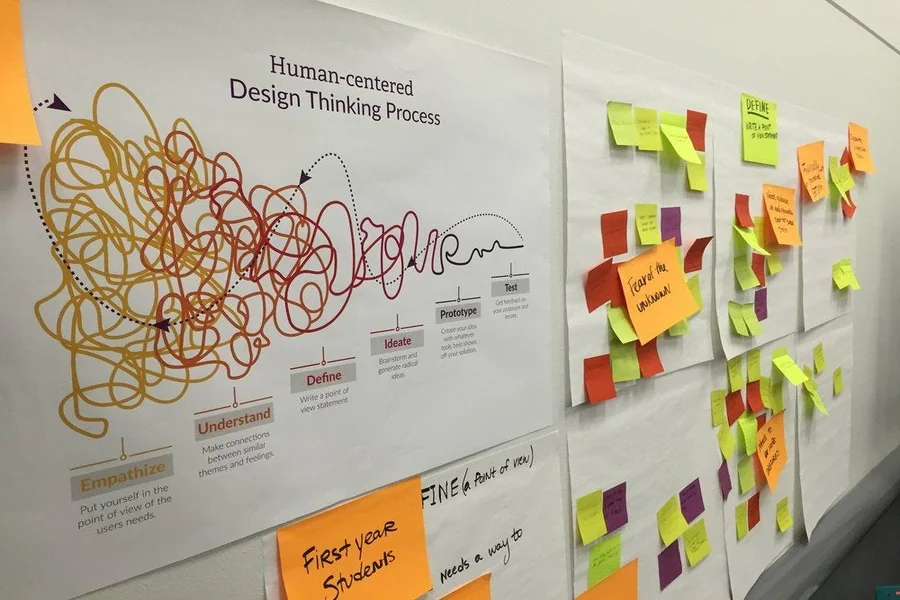
Most models (even the one taught in d.school at Stanford university) go through five phases. They are not a prescribed hierarchy. Groups back and forth as they gain knowledge.
- Empathize: Understand people you are designing for. Interviews, observation and surveys assist.
- Define: Convert learning into a problem statement. A good one identifies the user, the need and the “why it matters”.
- Ideate: List lots of solutions without prematurely assessing them. The amount is the most important part, the quality is secondary.
- Prototype: Producers create a quick, inexpensive model of the top ideas. This may be a sketch, mock-up or a simple process map.
- Test: Present the prototype to actual users, observe how they respond and make changes.
The beauty of this sequence is that errors occur at an early stage – when they cost less to rectify.
How Design Thinking for Business Innovation Works in Practice
Suppose that a medium-sized bank realizes that few millennials are signing up for savings accounts.Suppose that a medium-sized bank realizes that few millennials sign up for savings accounts. A traditional way of doing things may include a higher interest rate. A design thinking team will begin in a different way.
Their first step would be to engage the customers in that age group. They might find that people don’t distrust saving. They simply forget, or feel their small balances don’t matter. This insight is transformed into a problem statement: “Young customers want to save but they want this to happen without effort.
The team collaborates in a brainstorming session from there. It comes up with automatic transfer, round up features and graphical progress indicators. They create a simple model of the two highest and present it to a small number. It’s a matter of days, not months before you get feedback. The winning idea is fleshed out and then presented.
Observe what has occurred here. The team didn’t take a year to develop a project and then hope for the best. They learned and adapted and committed only when the evidence was solid. Design thinking for business innovation takes uncertainty in a process that is manageable.
Real-World Examples Worth Knowing
The mindset (or design thinking if they did use the term) has been adopted by several well-known companies.
Airbnb. In its days at the start, its founders observed that listings which had undesirable photos experienced fewer bookings. They got to visit hosts, took better photos themselves and their results improved. This was a small, practical test which helped to determine the course of the company.
Bank of America. The idea for the “Keep the Change” program was developed from watching how people managed their money at home. They observed that consumers rounded up their purchases in their checkbooks to make it easier to do the math, and to make it easier to save small amounts. The bank made that habit a characteristic and attracted millions of customers.
Procter & Gamble. The company has openly said that it has been thinking about the product development in a design-led way, instead of technical specifications, where consumers have been observed.
There’s no major budget or secret formula in all these stories. They provide a glimpse into what can happen when teams focus on real behaviour.
Key Benefits for Organizations
Companies that apply this approach tend to see practical gains:
- Lower risk. Testing early prevents costly failures.
- Better customer fit. Solutions match real needs, which supports stronger adoption.
- Faster learning. Short feedback cycles replace long planning phases.
- Stronger teamwork. People from different functions share one goal.
- Clearer decisions. Evidence from users reduces debates based on opinion.
These benefits build on each other. A team that learns faster makes better decisions, and better decisions reduce waste.
Common Mistakes to Avoid
Design thinking is not difficult to explain, but hard to get right. There are a number of recurring patterns.
Skipping the research. In some teams, brainstorming is done directly because it is a productive process. But with this lack of real user insight, the ideas are mere guesses with sticky notes attached.
Using it as a one off workshop. A two day session can unleash energy, innovation requires follow-through. The notes go into a drawer if you don’t test, and don’t need to iterate.
Being swept up by the initial vision. Prototypes are there for questioning. Without testing, the purpose of the process is lost if a team is supposed to defend their concept.
Leaving out decision-makers. Leaders who see only the end product might be reluctant to accept research-based ideas that have not been viewed by them. Include them in the process at an early stage.
Tools and Methods Teams Can Use
Special software isn’t needed to start. Most needs can be met with a few simple methods.
- User interviews: Brief, informal discussions that uncover needs and issues.
- Journey maps: A diagram of all the steps a customer takes, and notes on where the customer gets stuck.
- Empathy maps: Brief overview of what a user says, thinks, does, and feels.
- “How might we” questions: Questions that ask how problems can be transformed into opportunities: e.g., “How might we make onboarding feel easier?”
- Rapid prototypes: Paper sketches, clickable wireframes, or role played service scenarios.
Choose the lightest tool that addresses the question at hand. Large implements are not in use until the idea has earned them.
How to Start in Your Own Company
It is better to start small rather than embark on a company-wide initiative. This is a realistic trajectory.
- Select one problem from the real world. Choose a complaint problem that customers or employees have.
- Form a small, mixed team. The number of 3-6 is sufficient.
- Speak to at least 5 users. Patterns come up after several conversations.
- Formulate a problem statement. Limit to one or two sentences.
- Construct a working prototype within 2-3 weeks. The point is to get things done quickly, not in a polished manner.
- Experiment, observe, modify. Next, determine to continue, change direction or stop.
Stopping is an acceptable result. When you get word that an idea isn’t going to work, it’s a win, not a loss, before you invest millions of dollars.
How to Measure Results
Measuring innovation can be tricky, but there are indicators. Record the number of ideas tested, the duration of each test, and the number of ideas that went to launch. Once launched, monitor adoption rates, customer satisfaction, repeat use, and support requests. Reduction in complaints is as valid as an increase in sales.
There is also qualitative feedback that is important. If the words that your users are using to describe your product are identical to those you used in your problem statement, you’ve solved the right problem.
Final Thought
Good ideas don’t usually result from a guess. They are derived from observation, careful listening and willingness to be incorrect in the first couple of times. Design thinking for business innovation is a reliable method for teams to do just that. Use one real problem, meet a couple of real users, make a small thing. All subsequent decisions will be based on the lessons gathered.
FAQs:
What is design thinking in simple words?
It is a way of solving problems by understanding people first. Teams research user needs, test ideas quickly, and improve them based on feedback.
How is design thinking different from traditional planning?
Traditional planning builds a full solution before launch. Design thinking tests small versions early and adjusts along the way.
Can small businesses use design thinking?
Yes. It needs time and curiosity more than money. A small team can interview customers and test simple prototypes with very little cost.
How long does a design thinking project take?
It depends on the problem. Some projects produce useful prototypes in a few weeks, while complex products may take several months of cycles.
Do you need a designer to use it?
No. The method is open to anyone willing to listen to users and test ideas. Team members from any department can lead or join.
What industries benefit most?
It has been used in banking, healthcare, retail, education, and technology. Any field with customers or users can apply it.