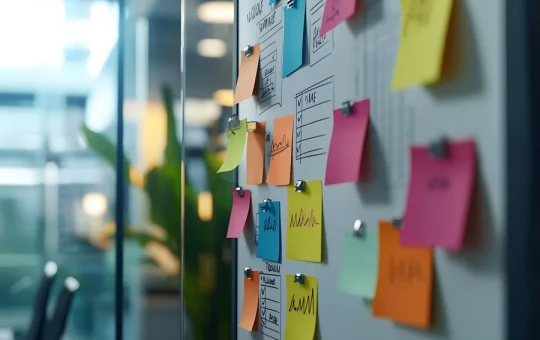
A creative case study is a brief, organized narrative that provides an example of how a creative solution addresses a business need and the positive outcomes generated by the creative solution. The case study usually contains some details regarding the client’s problem, concept for solution, solution development process, and the outcome. Creative professionals (designers, writers, marketers) and organizations (agencies) use creative case studies to showcase their knowledge, expertise and to explain their decision making process. A simple portfolio item shows visual and/or textual content, whereas a creative case study shows the “how” and “why” of the content creation and its usefulness to the user.
You may take weeks and spend all your efforts on a project you are very proud of. Then you can post all the completed images online for other people to view and very few will comment. This is usually because they are not aware of what you have done or why you did it and not because your work is poor.
What Is a Creative Case Study?
A creative case study is an explanation, either in writing or in visual form, of one project. A simple course that involves the problem, the method, the solution, and the result. It is basically the record of the accomplished job.
The structure is relevant to different industries. A graphic designer might use the process to describe a rebranding project and a copywriter might use the method to illustrate the effectiveness of an email series on signups. A photographer can describe the preparation that went into a photo shoot for a clothing line. The story can be told by an entire agency from beginning to end for an entire marketing campaign.
May be subject to variations in length between pages. Some case studies can be a single page, others can be several pages long with photos, quotes and statistics. The key is for the reader to get something out that they could understand what was done, and why it worked.
Why a Creative Case Study Matters
Few people choose a service provider purely based on aesthetic appeal. They’ll ask you if you are able to solve their issue. A case study provides a definite answer to that question.
Here are some of the things that a strong one can do for you:
- Establish trust: If it wasn’t a good result by chance, then you’ll demonstrate it by showing your process.
- Bring in superior customers: Clients who read about your thinking usually come in with clearer expectations.
- Justify your pricing: Your prices are more easily understood when you explain what value you provide.
- Better search engine optimization: Search engines can index text-based information better than just a gallery of images.
- Facilitate learning: Writing about a project helps you to reflect on what went well and what went badly.
A case study can be a substitute for a small number of clients for a beginner. Any personal or practice project can work if presented with honesty and an explanation of the goal.
Creative Case Study vs. Portfolio Piece
Many people confuse the two but the functions of the portfolio piece and case study are different. The result is the portfolio piece. Case study tells the process behind creating the outcome.
The portfolio piece is a response to the question, “What did you make? On the other hand, a case study answers the three questions, namely “Why did you create it like this?”, “What issue did it solve?” and “What happened after that?”
Every one has its own value. A portfolio is a quick visual indicator, a case study is a deep insight. Most professionals combine both; having a short link to their portfolio image and connecting them to the full case story.
Key Parts of a Strong Case Study
Case studies have a typical style. The order of the components can be changed but must contain each.
- Project Title and Summary: Begin with the project’s name, the client and a summary of your involvement.
- The challenge: Describe the challenge that the client had. It could be a goal, such as; raise brand awareness, grow sales, modernize design, etc.
- Your part: Say what it was your contribution in the project, if you were involved in the project with a group.
- Research: Give any information that you have found out about the target group, market or competitors before the project has been developed.
- The Idea: Share information on the main idea and why.
- Process: Add all the sketches and prototypes, tests and changes you have made during the project.
- Solution: Present the solution within the context.
- Results: Add numbers, feedback or any other information to show success.
- Lessons Learned: End the presentation with some thoughts or a statement from your client.
These are not all required for all the projects. If it’s a small project, then maybe just the challenge, idea and result.
How to Write a Creative Case Study Step by Step
You can ease your way into writing a case study by breaking it up into smaller tasks.
Step 1: Select the appropriate project. Select work that is aligned with the type of clients you are interested in. The five unrelated examples are not as good as a strong one with a clear relation.
Step 2: Gather materials. Collect briefs, correspondence, early sketches, drafts, final files and all data. It pays to take notes during the project – memory is a fickle thing.
Step 3: Establish the plot. Write in one sentence about what the project was. For instance: “A local bakery wanted a fresh appearance that appealed to younger individuals. All of the rest of the text should back up that sentence.
Step 4: Write the challenge first. Begin at the problem and not at yourself. Readers are interested in the problem first before the solution.
Step 5: Explain your decisions. Don’t just repeat what you have said. Say why. The logic for your color choices, headlines, layouts, or tone should be understood by a reader.
Step 6: Add proof. If you have any numbers, include them like traffic growth, sales growth, engagement rates, etc. If there are no data, use a client comment or a clear before and after comparison.
Step 7: Clarify the edit. Eliminate jargon, shorten repetitive topics and read them aloud. If a sentence doesn’t sound right, rewrite it.
Using Results and Evidence Honestly
The findings of a project are the essence of a case study, but don’t pretend to be something it isn’t, rather tell the truth. If you present any statistics that you are unable to substantiate later on, there will be trouble if your reader decides to investigate the facts.
If there were any results of the project, present them. Don’t use the words “the great improvement” instead use specific numbers and periods, such as, during three months. If it can’t be shown, because of confidentiality, then describe it generally, and provide a testimony.
If not all projects turn out successful, it’s okay because facing difficulties and changing the plan would make the case study more believable than a one that goes smoothly.
Tips for Making It Easy to Read
The clients tend to read the headlines first and then skim. When a client needs access to specific information, the formatting will be easier to find.
- Include proper headings that will allow readers to quickly skip to what they need.
- Keep paragraphs short – usually 3-4 sentences in length.
- Make sure that the images are next to the text to which they refer.
- Write a description for each picture.
- Make sure all numbers are highlighted on a different line.
- Make sure it concludes with a clear call-to-action, such as a contact link or form.
Images are important in creative writing but not in place of the story being told. Any visual page that has no text on it is a portfolio.
Common Mistakes to Avoid
Great creatives can still make mistakes when writing case studies. Be aware of these:
- Begin with the client: Do not start with your biography, begin with the problem.
- Not going through the process: Final images tell you nothing about the thinking process.
- Inappropriate jargon: Some terms may be foreign to the clients.
- Too long: Stray from what is supporting the story and go elsewhere.
- I didn’t reveal my role: If you participated in a team, you would report what you did in the team.
- The result is lost: A project that has no result makes the reader wonder what was accomplished.
A little help is provided there by a fast test. Have a friend outside of your field read it. If they can describe the results of what the project accomplished, you’re headed in the right direction.
Where to Publish and Share Your Case Studies
Once you have finished your case study, make sure it’s easy for others to find. Posting on your website is an excellent way to do this since you can control the information and can add links to your services. Many creative people tend to write short descriptions of their work, post them on a site that gets a lot of hits, and provide a link to the comprehensive description.
This content can also be repurposed! You can feature a quote from a client on your home page, an important image as the thumbnail and share an excerpt on social media. The case studies should be updated regularly for older ones.
Final Thought
A good creative case study adds voice to your work. It describes to the reader the problem you had, how you worked it out & what happened due to your intervention. An important client is not needed, nor is financial resources, in a good case study; it’s just clarity, honesty and simplicity. Begin with a single project and then follow the format stated above. With every new case you take up, you get better at writing a creative case study.
FAQs:
- What is a creative case study?
A creative case study is a short story of a creative project. It explains the problem, the idea, the process, and the results. - How long should a creative case study be?
Most run between 500 and 1,500 words, depending on the project. Keep it long enough to explain the story and short enough to hold attention. - What should I include in a creative case study?
Include the challenge, your role, the idea, the process, the final solution, and the results. A client quote adds extra credibility. - Can I write a case study without a real client?
Yes. A personal or practice project can work if you state the goal clearly and are honest that it was not for a paying client. - How is a case study different from a portfolio?
A portfolio shows finished work. A case study explains the reasoning, process, and outcome behind that work. - Where should I publish my case study?
Publish it on your own website first. Then share summaries on professional and social platforms with a link back to the full page.