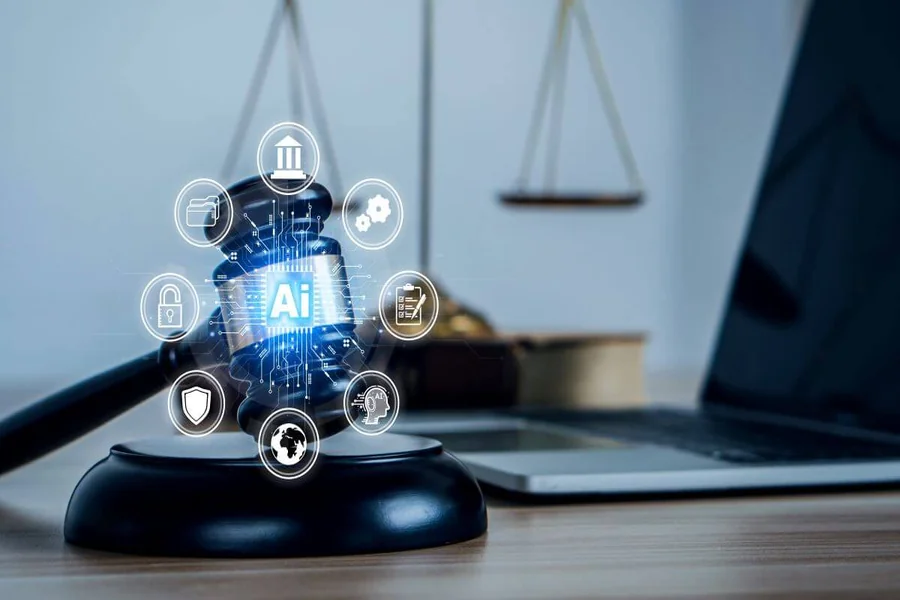
AI Regulation and Legislation: Challenges and Opportunities,AI has a major impact on hiring, banking, health, and everyday use of the internet. AI is affecting hiring, banking, and everyday life online these days. The more it spreads, the more pressure is applied on legislators to react.
This guide is on “AI Regulation and Legislation: Challenges and Opportunities” in layman’s terms. You will learn what the rules are and why these are difficult to formalize and how these can be useful to people and businesses.
Featured Answer: What Are the Challenges and Opportunities of AI Regulation?
The AI Regulation and Legislation: Challenges and Opportunities document describes the challenges and opportunities of regulating while innovating with AI. The key challenges are speed of technological development, differences in international legal obligations, and lack of clarity surrounding accountability. The biggest opportunities include gaining public confidence, a safer product, fairer markets and clear rules for business. Good laws will preserve man but not hinder good progress.
What Is AI Regulation and Legislation?
AI regulation is the guidelines, standards, and monitoring of AI systems. AI legislation is the enacting of the laws by the government to establish those rules.
They collaborate together to assist them in problem-solving:
- Who is liable for the damages if an AI system causes harm?
- What are the problems and problems that you are thinking of considering in the use of personal data for training models?
- What is to be done when people are notified that an AI decision has been reached on them, and when should they be notified?
The questions are the foundation of AI Regulation and Legislation: Challenges and Opportunities, setting the framework for growth and safety.
Why AI Needs Rules Now
AI may be misinformed, repeat inaccurate or biased information in the source data, and amplify misinformation at a high scale. Some systems can also be employed as a “black box” and even the manufacturer can’t explain a result.
There are a number of concerns that encourage governments to act:
- Bias and discrimination in the hiring process, lending policies and practices, and policing practices
- Collection of big data carries privacy concerns.
- Inaccuracies from fake media & deepfakes
- Healthcare, transport, and critical infrastructure security.
- The lack of transparency over the making of automated decisionsbox,”
The absence of rules makes it more difficult to prevent harm and for victims to find a remedy.
Major Challenges in AI Regulation and Legislation
Writing good AI law is difficult. Here are the biggest obstacles.
1. Technology Moves Faster Than Law
Laws take years to pass. AI models can change in months. A rule written for today’s tools may be outdated before it takes effect.
Many experts suggest flexible, risk-based rules and regular reviews to keep up.
2. Defining AI Is Not Simple
Lawmakers must decide what counts as an AI system. A definition that is too broad may cover ordinary software. One that is too narrow may miss new risks.
3. Different Rules in Different Countries
Each region takes its own path. This creates a patchwork that is costly for companies working across borders. It also allows regulatory gaps where risky systems can move to lighter-touch markets.
4. Unclear Accountability
An AI product may involve a data provider, a model developer, a company that deploys it, and an end user. When something goes wrong, assigning responsibility is hard. This is one of the toughest parts of AI Regulation and Legislation: Challenges and Opportunities.
5. Risk of Over-Regulation
Heavy compliance costs can hurt startups and small firms more than large companies. If rules are too strict, innovation may slow or move elsewhere.
6. Enforcement and Expertise Gaps
Regulators need technical skills to audit complex models. Many agencies are still building that capacity.
How Major Regions Approach AI Law
Approaches differ, but several patterns stand out.
| Region | General Approach | Key Example |
| European Union | Binding, risk-based law | The EU AI Act, in force since August 2024 with phased deadlines |
| United States | Sector-based rules, executive actions, and state laws | No single federal AI law; guidance such as the NIST AI Risk Management Framework |
| China | Targeted rules for specific AI uses | Rules on recommendation algorithms and generative AI services |
| United Kingdom | Principles-led, guided by existing regulators | Sector regulators apply shared AI principles |
| International | Voluntary or treaty-based cooperation | OECD AI Principles; Council of Europe AI convention |
Because these systems keep evolving, always check official government sources for the latest legal status.
The EU AI Act in Brief
The EU AI Act classifies AI systems according to the potential risks they pose. There are some bans, including some instances of social scoring. In high-risk systems, the system specifications are very strict, including documentation levels, human supervision, and testing. Transparency requirements are mostly applied to lower risk products.
In the most serious cases, fines may be up to 35 million euros or up to 7% of the worldwide turnover. This is especially important when it comes to the two key topics covered in this session: AI Regulation and Legislation: Challenges and Opportunities.
Key Opportunities Created by AI Regulation
Rules are seen as “burdens and restrictions. They may be effectively accomplished and have beneficial real world impacts.
Greater Public Trust
People will be more likely to use AI when they know it is tested and monitored. Trust can drive adoption in the case of sensitive industries like health and finance.
A modernisation of the rules for businesses.Modernisation of rules for businesses.
There are clear rules set by legislation, which removes uncertainty. Better product plans, budgets, and risk controls for businesses.
Said and fairer products
Testing, bias checking and documenting is an early driver in the development of improved systems.
Fairer Competition
Common standards’ advantages are that it stop a race to the bottom in which the least conscientious corporation gets the advantage by doing shoddy work.
Stronger Global Cooperation
Having common principles facilitates national harmonisation of rules. This decreases the expenses of doing business and business research.
A Market for Responsible AI
The landscape of AI auditing, risk management, and compliance is evolving with the emergence of new roles and services.There’s a new job or new service for each new development in the AI auditing, risk management and compliance field. It’s a definite upside in the area of AI Regulation and Legislation: Challenges and Opportunities.
Challenges vs. Opportunities at a Glance
| Area | Challenge | Opportunity |
| Innovation | Compliance costs may slow small firms | Clear standards can guide safe innovation |
| Global trade | Conflicting national rules | Shared frameworks can ease cross-border work |
| Accountability | Many parties share responsibility | Defined duties improve fairness for victims |
| Public trust | Fear of misuse and bias | Transparency and audits build confidence |
| Enforcement | Limited technical expertise | New careers and tools for oversight |
What Businesses Should Do Now
Whether you have to wait till all the laws are final, it doesn’t matter. There are measures that can be taken that mitigate risk now.
- Record the names of the AI systems and what they can be used for.
- Classify risk. Identify instruments that can impact recruitment, credit, work health, and safety.
- Write documentation of data sources and model training and testing.
- Introduce human oversight for critical decision-making.
- Check for bias and accuracy from time to time.
- Inform users when it is a product of AI.
- Monitor the laws in any market areas in which you trade.
An easy governance mechanism will also prepare you for future challenges and opportunities in AI regulation and legislation.
Best Practices for Lawmakers
Generally, the following principles are suggested for developing a successful AI law:
- Discuss the risk and actual harm, rather than particular technologies.
- Be flexible with rules to accommodate changes.
- Give clear directions to small businesses on supporting.
- Build up technical capacity and training in regulators.
- Engage industry, researchers, and the public and private sector.
- Arrange with international parties to the maximum extent.
Future Trends in AI Governance
- The future of AI law will be influenced by a number of trends:
- The guidelines for general-purpose and generative AI models have been expanded. Guidelines for general-purpose generative AI models have been expanded.
- Increased awareness of copyright and training data.
- Needs for transparency and explainability increase. Needs for an increase in transparency and explainability.
Rising use of AI audits and impact assessments. The use of AI audits and impact assessments is increasingly utilized.
Improved cooperation between countries in the field of safety standards.
The specifics will vary, but the principle will stay the same: to guard lives and to make productive progress. That’s the essence of AI Regulation and Legislation: Challenges and Opportunities, a book that is bound to be a standard text in the field for years of to come.
Final Thoughts
AI is a power that cannot be left unchecked and a power not to be restricted too much. AI Regulation and Legislation: Challenges and Opportunities is at its core.
The challenges are enormous: speedy transformation, global deficits, and ill-defined responsibilities. The opportunities are equally robust, though: trust, security, fair competition, and a healthier market for AI.
The most effective method is a combination of everything and/or nothing. There need to be definite rules in place for governments that address risks. Practices ought to be created early; businesses should. The reader is encouraged to stay up-to-date with the law.
The control and law of AI is gaining significance and is now becoming a “must-read” document. It’s a hands-on ability for any builder, buyer, or user of AI.
FAQs
What are AI regulation and legislation?
It is the collection of rules, laws, and standards to regulate the development and use of AI. It has the following goals: safety, fairness, privacy, and accountability.
Why is it so challenging to regulate AI?
Technologies are changing very fast, country definitions are not clearly defined, and there are conflicting opinions about what should be done in countries. The dilemma of safety, while balancing with innovation, gets even tougher.
Is there a worldwide rule of AI?
There is no international law that has been promulgated. Instead, regional laws, national laws, and international principles, such as those of the OECD.
What is the working of the EU AI Act?
It is based upon a risk-based model. More onus is on the more dangerous systems, and some bad uses are forbidden. The obligations are being realized step-by-step over a period of several years.
Will there be a negative impact on innovation from AI regulation?
If the rules are too complex or unclear, then it can. A more effective way to encourage innovation is to create trust and clear expectations through well-written rules.
What is AI, and how can it impact small businesses?
Start by reviewing your AI tools, conducting a risk assessment, and documenting data usage and involving human decision makers. Please adhere to official instructions in your market.