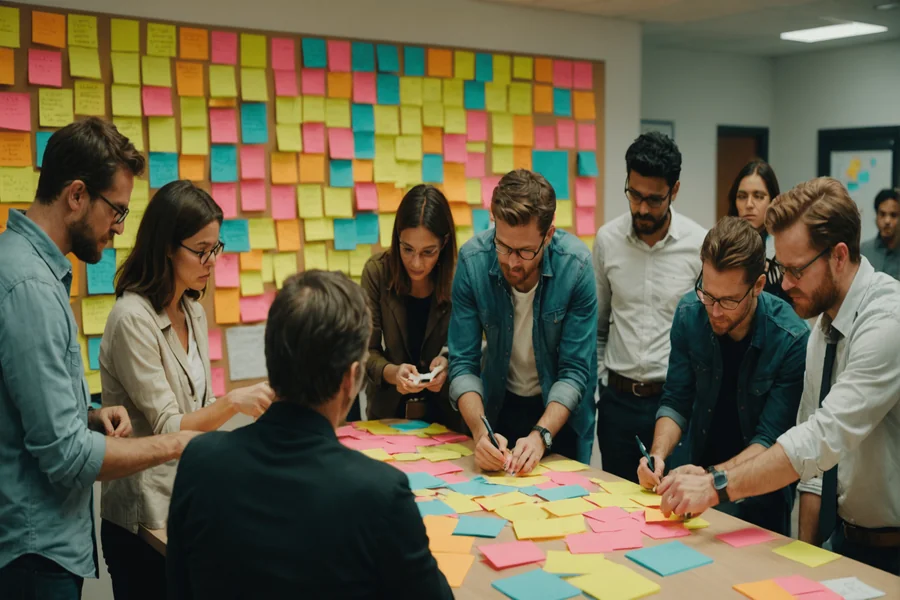
A brainstorming workshop is an organized meeting during which the members brainstorm new concepts, discuss them, and develop them. The brainstorming workshop is used to analyze a problem, discuss opportunities, refine a product, and be creative. A brainstorming workshop instead of relying on one person or one department involves having various perspectives present in the same discussion.
Ever had a good idea that you couldn’t get going with? That initial thought can be transformed into a practical application using a brainstorming workshop. A business will be able to find possibilities that may not show up in regular meetings when employees, customers, specialists, and partners offer different viewpoints.
This article provides an explanation for what a brainstorming workshop is, how it works, the primary formats available for a business to use, advantages, disadvantages, and how to conduct an effective workshop.
What Is a Brainstorming Workshop?
Brainstorming is a workshop, not just a brainstorming session. It’s a deliberate creative process where it is intended to ideate as many useful ideas as possible first and then select those that warrant further consideration.
A successful brainstorming workshop often starts off with a specific problem or objective. Then the participants brainstorm without giving judgment on the ideas. After ideas are gathered, the group can arrange, consider, prioritize, and create the best possible ideas.
The power of a brainstorming workshop is in the synergy of thinking. A marketing person could perceive a problem in a different way than an engineer, customer service, sales, or finance professional.
Why Businesses Use Brainstorming Workshops
Brainstorming workshops are held by companies when they are in need of new solutions and ideas instead of answers. These sessions are beneficial during product or market launches, when improving the customer journey or addressing an operational challenge.
An effective brainstorming workshop can also help overcome departmental obstacles. Those who don’t work with each other very often can offer ideas and know how other groups tackle the same issue.
The objective is not to just gather a long list of ideas. The best brainstorming workshop sets up a process that can ultimately turn a great idea into actionable steps.
Who Should Attend a Brainstorming Workshop?
For a brainstorming workshop to be effective, the group needs to be representative of the problem that is being discussed. Designers, engineers, marketers and representatives of customers may be needed during a product-development session. Leaders, analysts, sales professionals, and outside experts can all be needed for a business strategy session.
The results are usually better from a diverse brainstorming workshop, as they come from different experiences and assumptions. The group should not grow too big, however, so that individual group members do not continue to participate.
A small and specific brainstorming session can be easier to control for most teams than a large meeting.
How a Brainstorming Workshop Works
A typical brainstorming workshop can be divided into several stages.
1. Define the Goal
All brainstorming sessions should begin with a question or challenge. Rather than asking “How can we improve the business?” ask a more specific question, such as, “How can we reduce customer waiting time by 20%?”
A clear question provides a direction for the brainstorming workshop while not restricting creativity.
2. Generate Ideas
n this phase of the brainstorming workshop, as many ideas as possible are put forward. Emphasis is on quantity, exploration, and not immediate judgment.
Sticky notes, digital boards, shared documents, or other collaboration tools can be used to write their ideas.
3. Organize the Ideas
After generating ideas, the brainstorming workshop moves into a sorting stage. The same types of suggestions may be clustered, and unusual suggestions can be saved for further discussion.
This stage will enable participants to gain insight into patterns they may have missed during the initial brainstorming session.
4. Evaluate Options
The next step is to identify ideas to consider. Brainstorming workshop can be based on business impact, risk, feasibility, time, customer value, and/or cost.
Ideas with the most merit can then proceed to testing or implementation.
Popular Brainstorming Workshop Formats
The format isn’t standard for all companies. There may be more than one way to solve a problem.
Traditional Group Brainstorming
The traditional brainstorming workshop is one in which all group members sit down together and brainstorm ideas verbally. A facilitator takes notes and helps the discussion along.
When the group is already comfortable communicating, this is the method that is best suited.
Brainwriting
Brainwriting brainstorming is a brainstorming session in which ideas are written down first and then discussed. This allows quieter people to participate without getting interrupted by more talkative people.
Online Brainstorming
A virtual brainstorming workshop is a session that brings remote employees, customers, or partners together by utilizing digital collaboration tools.
This can be helpful for distributed teams to work together.
Customer-Focused Sessions
Customer feedback or active participation of customers in a brainstorming session is part of a customer-focused brainstorming workshop. It can assist companies comprehend genuine requirements rather than entirely relying on assumption from within.
Benefits of a Brainstorming Workshop
An effective brainstorming session can generate a number of tangible outcomes.
More Ideas
The most important thing about a brainstorming workshop is that it allows for several ideas. But one person’s suggestion might lead to a completely different idea from another participant.
Diverse Perspectives
Brainstorming workshop can convene members of a cross-professional group. That variety can lead to possibilities that one team may not see.
Better Collaboration
The attendees will leave a brainstorming session with a better grasp of the thinking and working process of other departments.
Faster Problem Solving
One hour or a day of brainstorming can take the place of hours or days of individual thinking.
Employee Engagement
During a brainstorming workshop, it can be beneficial to involve them and give them a voice in key business decisions.
Customer Understanding
Client or client-facing staff involvement in a brainstorming workshop can uncover issues that might not be reflected in an internal report.
Challenges of Brainstorming Workshops
While useful, a brainstorming workshop does not necessarily succeed. A well planned activity can turn into a meeting gone wrong as a result of poor planning.
Dominated by a small number of players is one of the common issues. If just one person is talking, other thoughts might not be heard.
Early criticism is another issue. If all ideas are turned down, participants can discontinue sharing of creative suggestions.
Brainstorming can generate hundreds of ideas without determining what needs to be done next, if it’s not facilitated properly.
Time management is another challenge. A brainstorming workshop must have sufficient time to investigate ideas, but should contain a definite framework.
How to Run an Effective Brainstorming Workshop
Identify the goal of the brainstorming workshop. The participant(s) should have the question they are attempting to answer in mind.
Select the appropriate people to participate. Brainstorming workshop can be more productive by using a combination of skills and perspectives.
Provide background information prior to session. The participant(s) can then arrive to the workshop with a brain and ready to brainstorm, rather than trying to comprehend the problem first.
Appoint a facilitator. The facilitator maintains focus of the brainstorming, prompts quieter group members and prevents the group from being dominated by one member.
Create simple rules. For instance, participants can agree to listen carefully, give no personal criticism, add to others’ ideas and concentrate on the challenge.
Do use a system that allows for ideas to be captured that is easily seen. At the brainstorm workshop, he or she should be able to view the ideas that have been put forward.
Lastly, determine the follow-up actions you will take. The most productive brainstorming session is of no use if great ideas are lost after the meeting.
Tools for a Brainstorming Workshop
For an in-person brainstorming workshop, physical sticky notes are still very helpful in moving ideas and group formation.
Digital whiteboards can be used to facilitate the brainstorming session online for a remote workshop by enabling participants to write notes, drawings, diagrams, and comments.
At the end of a brainstorming workshop, voting tools can be used to prioritize ideas. The participants can award points or votes to the ideas they think can have the highest potential.
Project-management systems can then monitor what happens following the brainstorming workshop.
It is not the tool, it is its use. The tool should facilitate a brainstorming workshop and facilitate documentation.
Brainstorming Workshop Examples
Suppose a software firm desires to minimize the amount of complaints from its customers. It might be an idea brainstorming session with the customer service team, the product team, the engineering team and the marketing team.
Many complaints may be because of unclear onboarding instructions and not software bugs.
A brainstorming session could be conducted with a retail company to see how their shopping experience can be enhanced. Staff could recommend improved store layout, individual store recommendations, new store loyalty packages, or quicker checkout.
One way to improve student services could be through a brainstorming workshop at a university for students and faculty, where they are asked to brainstorm ideas on how to improve the services provided to students.
A brainstorming workshop might be helpful for a start-up company to discuss with others what customers need, pricing alternatives, marketing messages, risks, etc. before introducing a new product into the market.
The following examples illustrate how a brainstorming workshop may be used for nearly any business or organizational problem.
How to Measure a Brainstorming Workshop
It is not sufficient to simply count the number of ideas in a brainstorming workshop to decide whether it has been successful or not.
The number of ideas created, the number of ideas chosen for testing and the percentage of real projects can be measured.
They can also ask participants if the brainstorming workshop was helpful in understanding the problem.
Business impact is another helpful criterion to consider. The brainstorming workshop has resulted in an idea that will save money, enhance customer satisfaction, or generate new revenue; it has been worth the time invested.
Tips for Better Brainstorming Workshops
Stay on track with the challenge.
Encourage people of diverse experiences.
Provide time for participants to reflect independently.
Don’t be too hasty to make judgments.
Invite participants to add on to suggestions.
Utilize visual aids as needed.
Focus the session.
Write down all the ideas that might be a good idea.
Close with specific priorities.
Ownership is to be allocated following the brainstorming workshop.
In particular, ensure the participants know that creativity is welcomed. Brainstorming workshops should be different than a normal status meeting.
Brainstorming Workshop vs. Ordinary Meeting
An ordinary meeting often exists to share information, make decisions, or review progress. A brainstorming workshop, by contrast, is designed primarily to explore possibilities.
The difference is important. If participants enter a brainstorming workshop expecting only one correct answer, they may reject unusual ideas too quickly.
A productive brainstorming workshop gives participants permission to explore before narrowing their options.
The Role of the Facilitator
The facilitator plays one of the most crucial roles of a brainstorming workshop. They’re not responsible for giving you all the answers. Rather, they set-up a place where other people can contribute.
A good facilitator asks pertinent questions, controls timing, avoids interruptions, ensures all voices are listened to.
They also are used to help transition the brainstorming workshop from the creative to actual decision-making process.
Final Thoughts
Brainstorming workshop is a procedure that helps teams convert various points of view into practical ideas. It can be a tool for problem solving, product development, customer understanding and opportunity identification.
Typically, good outcomes are achieved through preparation, varied involvement, effective facilitation, and follow-up.
Brainstorming workshops may be useful when your team has been considering the same issue without any breakthroughs. Begin with one targeted challenge, engage the right people, develop a space for ideas and then move those most compelling ideas into action.
FAQs
1. What is a brainstorming workshop?
A brainstorming workshop is a structured collaborative session where participants generate, discuss, organize, and prioritize ideas around a specific problem or goal.
2. What is the purpose of a brainstorming workshop?
The main purpose of a brainstorming workshop is to generate creative ideas and identify practical solutions by bringing different perspectives together.
3. How long should a brainstorming workshop last?
The ideal length depends on the problem and group size. A focused brainstorming workshop can often work well within one to two hours, while more complex challenges may require longer sessions.
4. Who should attend a brainstorming workshop?
The participants should have relevant knowledge, different perspectives, or direct experience with the problem. A balanced brainstorming workshop usually includes people from more than one role or department.
5. What makes a brainstorming workshop successful?
Clear objectives, good facilitation, diverse participation, open communication, effective idea capture, and strong follow-up can make a brainstorming workshop successful.
6. Can a brainstorming workshop be done online?
Yes. A virtual brainstorming workshop can use video meetings, digital whiteboards, shared documents, and online voting tools to support collaboration.
7. What should happen after a brainstorming workshop?
After a brainstorming workshop, the team should review the ideas, prioritize the strongest options, assign responsibility, and decide which ideas should be tested or developed further.