The 10-year-old factories have changed. Data sharing, software identification of problems at an early stage, and robots operating alongside people. By knowing the leading 5 manufacturing technology trends, manufacturing leaders can focus investments and prioritize where they should invest in resources.
Below is a description of each trend in layman’s terms. You’ll find out what it is, what it fits, and what to expect. So, Top 5 Technology Trends Transforming Modern Manufacturing
What Are the Top 5 Technology Trends Transforming Modern Manufacturing?
Artificial Intelligence, the Industrial Internet of Things, Collaborative Robotics, Digital Twins, and Additive Manufacturing are the 5 technology trends that are revolutionizing today’s manufacturing. They can help the factories to foresee failure, reduce waste, increase production efficiency, and guarantee the quality standard together. These trends illustrate various needs, and manufacturers will benefit the most from taking a small step, selecting a single need, and linking these tools together with trusted and widely shared data.
Why the Top 5 Technology Trends Transforming Modern Manufacturing Matter Now
The pressure on the manufacturers is always ongoing. More rapid delivery time is required, and more custom products. Material or materials and energy prices are uncertain. There are few people around with talent. Expectations for quality are continually increasing.
The top 5 technology trends that are changing modern manufacturing are responding to these challenges. They provide plants with increased visibility, fast decision-making, and flexible production lines.
They also help to achieve the goals of Industry 4.0, smart factories, lean manufacturing and resilience of the supply chain.
Quick Overview of the Top 5 Technology Trends Transforming Modern Manufacturing
| Trend | What It Does | Main Benefit | Good First Use |
| AI and machine learning | Finds patterns in factory data | Fewer breakdowns and defects | Predictive maintenance |
| Industrial IoT (IIoT) | Connects machines and sensors | Real-time visibility | Machine monitoring |
| Collaborative robots (cobots) | Handle repetitive tasks beside workers | Steady output, safer work | Packing or machine tending |
| Digital twins | Create a virtual copy of assets or lines | Safer testing of changes | One critical machine |
| Additive manufacturing | Builds parts layer by layer | Faster prototypes and spare parts | Tooling and fixtures |
1. Artificial Intelligence and Machine Learning
AI is often the first name people think of in smart manufacturing. Machine learning models study data from machines, cameras, and quality checks. They find patterns that people may miss.
Common uses include:
- Predictive maintenance: spot signs of wear before a machine stops.
- Visual inspection: cameras flag defects on the line.
- Demand forecasting: plan production using sales and market data.
- Process tuning: adjust settings to reduce scrap and energy use.
Unplanned downtime is expensive, so catching issues early has real value. Among the top 5 technology trends transforming modern manufacturing, AI also depends the most on good data. Poor sensor data leads to poor predictions.
Start with one machine or one defect type. Prove the value, then scale.
2. Industrial Internet of Things (IIoT) and Smart Sensors
IIoT connects machines, sensors, and software so they can share information. Sensors measure things like temperature, vibration, pressure, and speed. The data flows to dashboards that show what is happening on the floor right now.
Many plants also use edge computing. This means data is processed near the machine, so alerts arrive in seconds instead of waiting on a distant server.
Key benefits include:
- Real-time visibility across lines and plants
- Better traceability of parts and batches
- Easier energy and equipment monitoring
- Cleaner data for AI and digital twins
IIoT is the base layer for the other trends. Without connected data, most advanced tools struggle.
One caution: more connected devices mean more entry points for attackers. Cybersecurity must be part of the plan from day one.
3. Collaborative Robots and Advanced Automation
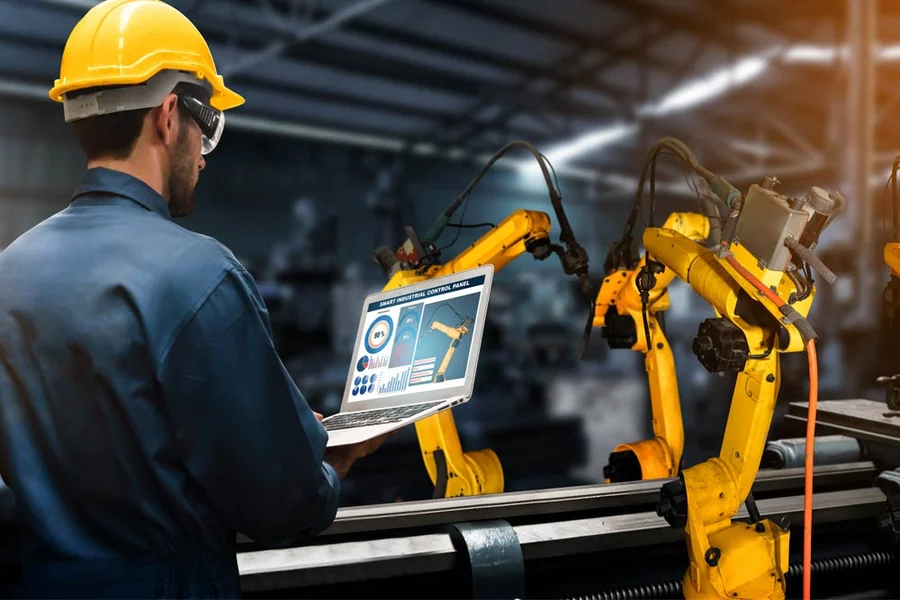
Traditional industrial robots often work inside safety cages. Collaborative robots, or cobots, are built to work near people using sensors and force limits.
They handle repetitive tasks such as:
- Packing and palletizing
- Screwdriving and assembly
- Machine tending
- Quality checks
Cobots are usually easier to program and move between tasks. This makes them a good fit for small and mid-size manufacturers that run many product types in small batches.
Autonomous mobile robots (AMRs) add to this trend by moving parts and materials around the plant without fixed tracks.
Still, a risk assessment is needed before any robot works near people. Cobots also do not remove the need for workers. They shift people toward supervision, setup, and problem solving.
4. Digital Twins
A digital twin is a virtual copy of a machine, a production line, or a whole factory. It is updated with real data from the physical asset.
Teams can use it to test changes without stopping production. For example, they can try a new layout, simulate a faster line speed, or check how a new product will run.
Common uses include:
- Planning factory layouts
- Monitoring equipment health
- Training operators in a safe setting
- Testing new product runs before launch
This ability to test first and act second is why digital twins sit among the top 5 technology trends transforming modern manufacturing.
A twin is only as good as its data. Building one takes time and skill, so begin with a single critical asset rather than the whole plant.
5. Additive Manufacturing (Industrial 3D Printing)
Additive manufacturing builds parts layer by layer from a digital file. It started with prototypes, but its role keeps growing.
Manufacturers now use it for:
- Fast prototypes
- Custom tooling, jigs, and fixtures
- Complex shapes that are hard to machine
- On-demand spare parts
Printing spare parts when needed can reduce stored inventory. It can also shorten waiting times for hard-to-find components.
There are limits. Print speed, material choices, and testing requirements for critical parts can hold it back. In most cases, additive manufacturing complements traditional methods rather than replacing them for high-volume production.
Benefits and Limits at a Glance
| Trend | Key Strength | Main Limit |
| AI and machine learning | Predicts issues early | Needs clean, steady data |
| IIoT | Real-time visibility | Cybersecurity risk |
| Cobots | Flexible, easy to redeploy | Slower than caged robots for some tasks |
| Digital twins | Safe testing | Setup effort and data accuracy |
| Additive manufacturing | Design freedom, fast parts | Material and speed limits |
How to Adopt the Top 5 Technology Trends Transforming Modern Manufacturing Step by Step
- Does not have to be done at one time. It’s better to have a simple path.
- Choose one of the business problems. Excessive downtime, excess scrap, too slow of changeovers, etc.
- Check your data. Provide correct and easily accessible sensors and records.
- Run a small pilot. Choose any line, machine or product.
- Measure results. Keep track of downtime, defect rates, output and cost.
- Train your team. They enable people to make them work; make investments in their upskilling.
- Scale what works. Only expand when the pilot has been successful.
Common Challenges and Simple Fixes
Even the best of the top 5 technology trends transforming modern manufacturing can fail without planning. These are the most common problems.
| Challenge | Why It Happens | Simple Fix |
| Poor data quality | Old machines, missing sensors | Audit data first and upgrade key points |
| Staff resistance | Fear of job loss or change | Explain goals and offer training |
| High upfront cost | Equipment and software spending | Start with a small, high-return pilot |
| Cybersecurity gaps | More connected devices | Use network separation and access controls |
| Disconnected systems | Tools from different vendors | Choose open standards and plan integration |
Final Thoughts
It’s not just a list of buzzwords that the top 5 technology developments changing the face of modern manufacturing are. These are simple and straightforward tools that can be utilized to cut manufacturing downtime, enhance product quality, and accelerate the speed to client.
The best strategy is to not rush into using any new tool. Try to keep the problem simple; do a small thing and make adjustments based on the outcome. The strong data, secure systems, and well-trained people are as important as the technology.
When manufacturers understand the 5 top technology trends that are impacting manufacturing today, that’s when they’ll be prepared for tomorrow.
FAQs
Then what are the top 5 modern manufacturing technology trends?
All of these are examples of AI and machine learning: the IIoT, collaborative robots, digital twins, and additive manufacturing. All of these contribute to different aspects of the production planning and quality control.
What do you mean by Industry 4.0 in Manufacturing?
Industry 4.0 is an evolution towards data-enabled, Internet-integrated factories. It can leverage sensors, software, automation, and analytics to enable machines and humans to make faster, better decisions.
So, which trends in technology should the small factories focus on, changing the manufacturing space in the world?
Small factories start their journey with IIoT sensors or cobots, as both can be added in increments. Choose the one that you have the most problem with, e.g., downtime or slow and repetitive tasks.
How can AI help the manufacturing industry?
AI can analyze visuals and sensor data to make quality checks. It detects defects early on, thus minimizing waste and rework. It can also apply to a reiterating issue that is attributed to process settings.
Will the workers in the manufacturing industry be replaced by automation?
Jobs are not lost due to automation, they are simply changed. Automated jobs are the first to go, and jobs like technicians, data analysts and robot supervisors are increasing in demand. Training is key.
Does 3D printing make for mass production?
Mostly not yet. Best used for prototype, tools, custom parts and spare parts. Typically, larger production runs cost less and are faster using traditional methods.